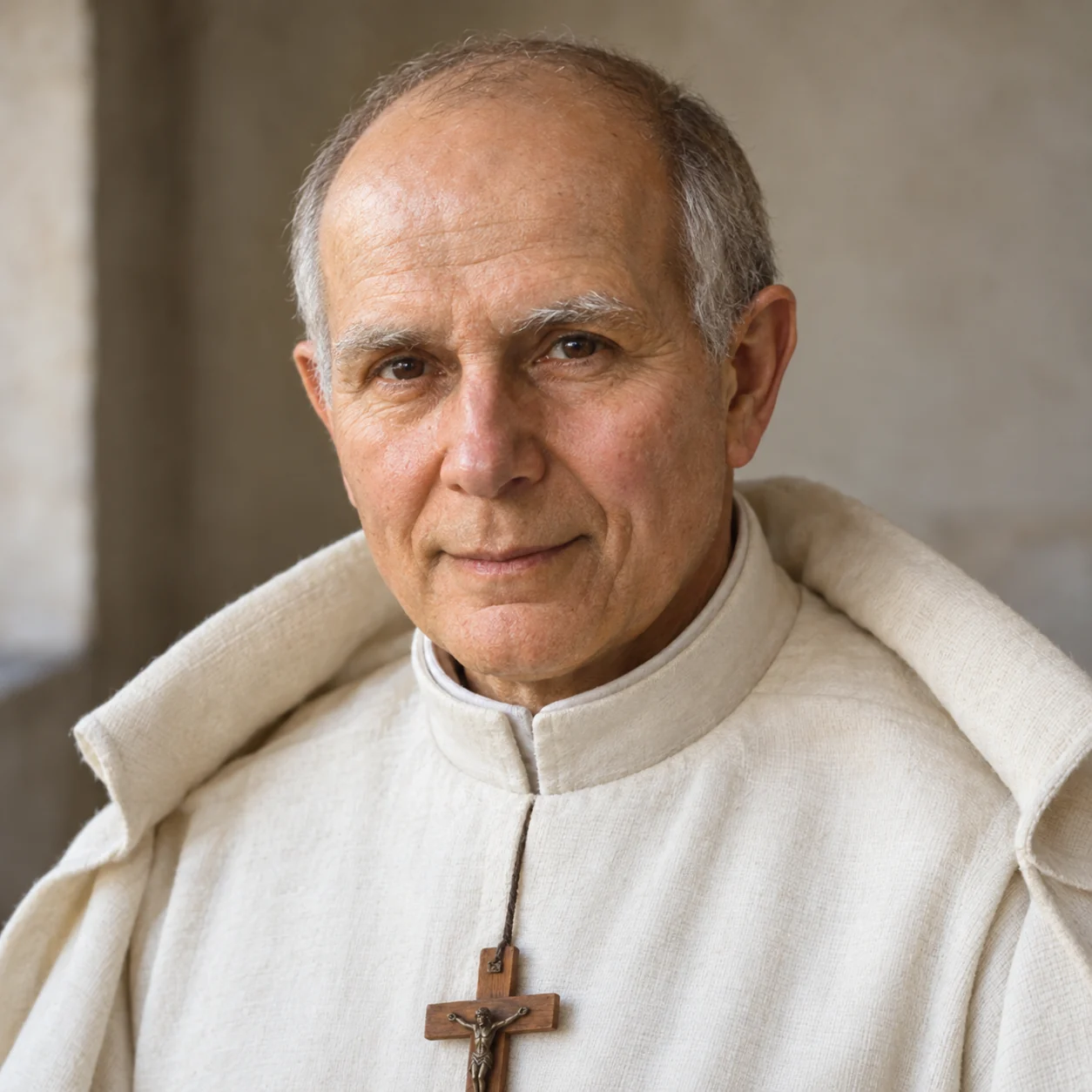
Saint Stanislaus Papczyński
Priest · 1631-1701
Priest, founder of the Marian Fathers, preacher
Jan Papczyński was born into a large family (he had a brother, Piotr, and 6 sisters), the son of Tomasz, a blacksmith, and Zofia, née Tacikowska. He had trouble learning to read and write. As a child he played differently from other children. He made little “altars” and organized processions like those in church. From his early youth he was distinguished by a great devotion to Divine Providence, the Passion of the Lord, the Blessed Sacrament, and the Blessed Virgin Mary, and he was also an ardent advocate of prayer for the souls in purgatory.
After completing three years of parish elementary school and two grammar classes, in 1646 he went to Jarosław to complete the third class at the Jesuit college. After a few months of study he left Jarosław for Lviv to continue his education. There he fell seriously ill, and as a result he wandered the streets for some time, begging for alms. Found by his father, he returned home, and after recovering his health he went in 1649 to the Piarist college in Podoliniec, where he completed the third grammar class. Then, because of a raging plague and the closing of the Piarist school, he returned home and continued his studies with the Jesuits in Lviv and later in Rawa Mazowiecka, where he completed rhetoric and a two-year course in philosophy. He was a devout young man, given to mortification, in love with learning and prayer and with devotion to the Mother of God, traits he had brought from the atmosphere of his family home and his pious parents.
His parents found him a beautiful bride with a good dowry. But he dreamed of something entirely different. In July 1654 he left his family home. He received the habit in the Piarist Order and was given the name Stanislaus of Jesus and Mary. A year later he went to Warsaw for theological studies, and there, on July 22, 1656, he professed his religious vows.
The year 1670 was a turning point in the life of Stanislaus Papczyński. At that time he left the Piarist Order. He felt that some of his confreres had departed from their original zeal in keeping their vows and were devoting too much of their time to worldly pleasures. He himself renewed his promise to persevere in the strict observance of the evangelical counsels. In September 1670 he put on a white habit, meant to symbolize the immaculate purity of the Mother of God. He wanted to imitate her to the end of his life. He longed to found an order of men devoted to honoring the Immaculate Virgin Mary. Fulfilling this desire took him the next dozen or so years.
Saint Stanislaus of Jesus and Mary Papczyński died on September 17, 1701, in Góra Kalwaria, by then superior general of the Congregation of Marian Fathers, the first religious order of men founded in Poland. The many graces received by those who prayed at Father Stanislaus’s tomb earned him the title “renowned for miracles.” This is how the Coronation Sejm of King Stanisław Poniatowski described the founder of the Marians in 1764, when it petitioned the Holy See for his beatification.
To this day his mortal remains are venerated in the tiny church at Marianki in Góra Kalwaria. Father Stanislaus was beatified on September 16, 2007, in Licheń by Cardinal Tarcisio Bertone, the papal legate. He was canonized on June 5, 2016, by Pope Francis. His liturgical memorial is celebrated on May 18, the day of his birth.
Before the beatification ceremony, the Marian Fathers, using modern anthropological methods, had the skull taken from the blessed’s tomb undergo a computer reconstruction at the Department of Forensic Medicine of the Medical University in Poznań, in order to show what his face looked like. As a result of this research, a likeness of his face was produced.
Father Papczyński is sometimes described as “a tough guy in a habit.” He could not be discouraged. He did not let anyone steal his hope. He urged his confreres: “Pray, brothers, for the souls in purgatory, for they suffer unbearable torments.” He knew that many soldiers were dying without being reconciled with God. He was also aware that a great multitude of people were dying in frequent epidemics. He taught that it is the duty of a Christian to help them through prayer. Testimonies from various parts of the world show that childless couples, mothers in high-risk pregnancies, people struggling with addictions, families in conflict, and children and young people with learning difficulties can count on Saint Stanislaus’s special support in prayer.