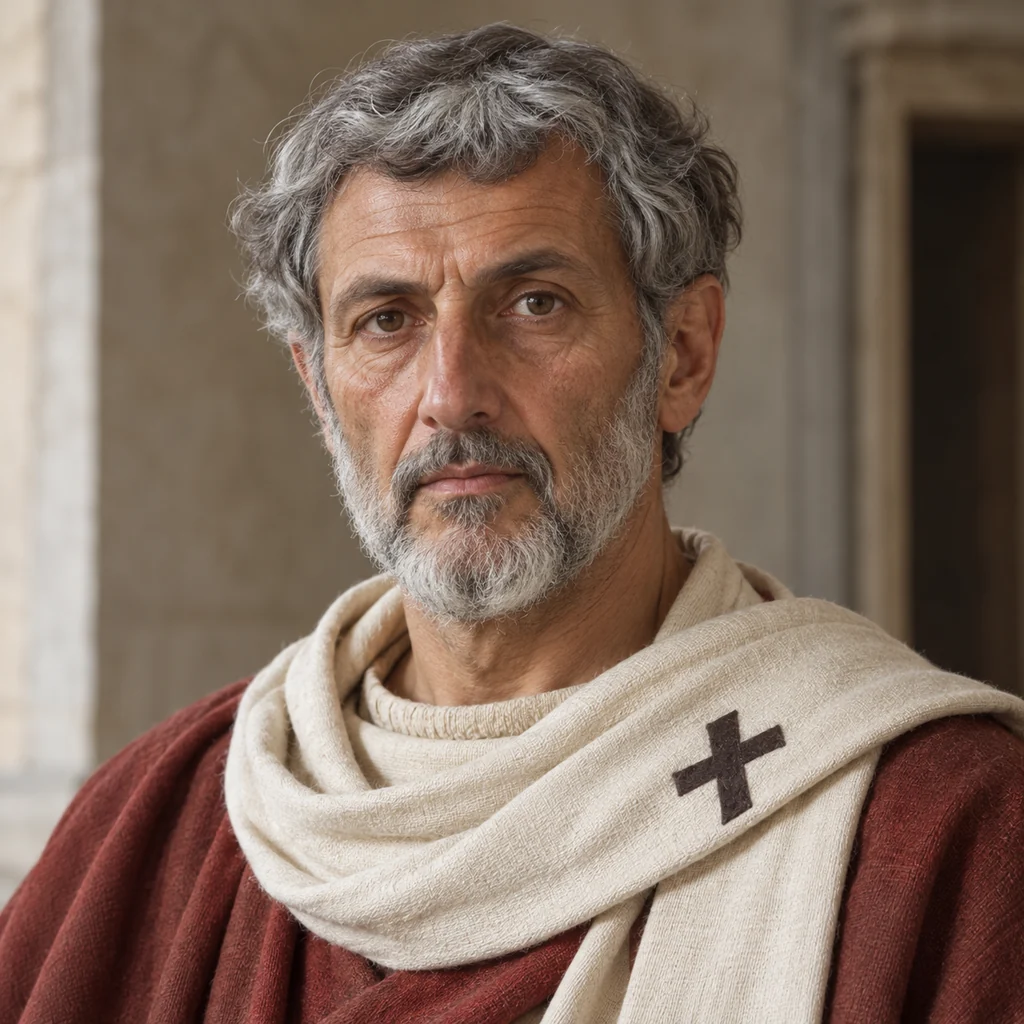
Saint Leo the Great
Pope · † 461
Pope and Doctor of the Church, teacher of the faith in the Incarnation, defender of Rome
Saint Leo the Great was pope from 440 to 461 and is a Doctor of the Church. He led the Church at a time when the empire in the West was weakening under the pressure of invasions, and his teaching on Christ, true God and true man, was received at the Council of Chalcedon. The Church commemorates him on November 10.
He came from Tuscany, the ancient Etruria, and spent his early years in Rome, which he called his homeland. He was born toward the end of the fourth century; the exact year is unknown. Around 430 he was a deacon of the Church of Rome. In 440, at the request of the imperial court, he went to Gaul to reconcile two high officials who were at odds. There the news reached him that Pope Sixtus III had died and that Leo had been elected to succeed him. After returning to Rome he was ordained bishop on September 29, 440.
He is the first pope whose sermons to the people have come down to us: almost a hundred of them survive, as well as about a hundred and fifty letters. In them he explained the mysteries of faith celebrated in the liturgy and taught that they are not only a memory of the past but are at work in the lives of believers. In a Christmas sermon he cried out: “Christian, recognize your dignity.” In a Rome tried by famine and an influx of refugees, he stirred up works of charity and joined fasting to almsgiving.
When in the East the monk Eutyches began to deny the true humanity of the Son of God, Leo set out the faith of the Church in a letter to Flavian, bishop of Constantinople, known as the Tome to Flavian. In 451 it was read at the council in Chalcedon, over which the pope’s legates presided. The bishops received the letter with the acclamation: “Peter has spoken through the mouth of Leo.” The council professed that in the one person of Christ two natures, divine and human, are united without confusion and without separation.
In 452 the Huns under Attila devastated northeastern Italy. The pope set out with a Roman delegation, met Attila near Mantua, and persuaded him to break off the invasion. In the spring of 455 he was unable to stop Genseric’s Vandals, who plundered defenseless Rome for two weeks. Yet he went out with his clergy to meet the invader and obtained this much: the city was not burned, and the basilicas where part of the population had taken refuge were spared.
He died in Rome in November 461, after more than twenty-one years as pope. November 10 is usually given as the day of his death; the Roman Martyrology recalls on that day the laying of his body to rest near the tomb of Saint Peter. Today Leo’s relics rest in one of the altars of the Vatican Basilica.
Leo has been venerated as a saint since antiquity, without a formal canonization, and the title “the Great” was given to him by tradition. In 1754 Pope Benedict XIV proclaimed him a Doctor of the Church. He was the first bishop of Rome to bear the name Leo; thirteen popes have taken it after him, most recently Leo XIV in 2025.