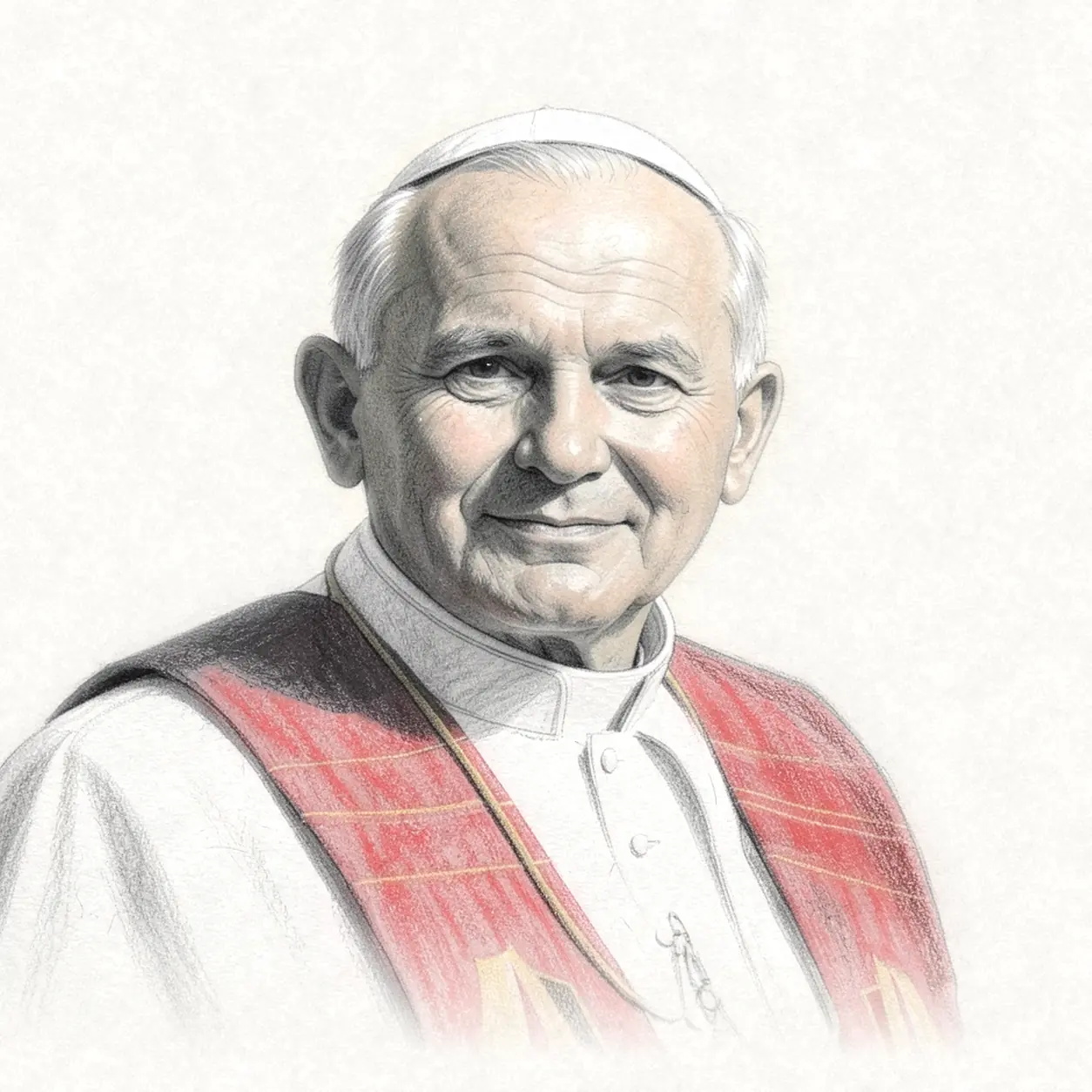
Saint John Paul II
Pope · 1920-2005
Pope, pilgrim, initiator of World Youth Day
Saint John Paul II, Karol Józef Wojtyła, was pope from 1978 to 2005, the first from Poland and the first from outside Italy since the time of Adrian VI. His liturgical memorial falls on October 22, the anniversary of the solemn beginning of his pontificate in 1978.
He was born on May 18, 1920, in Wadowice. He lost those closest to him early: his mother, Emilia, died in 1929, his older brother Edmund, a physician, in 1932, and his father, Karol, in 1941. In 1938 he began his studies at the Jagiellonian University in Krakow.
When the German occupiers closed the university in 1939, he worked in a quarry and then at the Solvay chemical plant to earn a living and avoid deportation to Germany. From 1942 he prepared for the priesthood in the clandestine seminary of Krakow, which was directed by Archbishop Adam Stefan Sapieha. He was also one of the founders of the underground Rhapsodic Theater. He was ordained a priest in Krakow on November 1, 1946, and in 1948 he earned a doctorate in theology in Rome with a dissertation on faith in the writings of Saint John of the Cross.
After returning to Poland he served as a parochial vicar in Niegowić and at Saint Florian’s parish in Krakow and as a university chaplain, and later he taught moral theology and ethics in Krakow and in Lublin. In 1958 Pope Pius XII appointed him auxiliary bishop of Krakow. Paul VI entrusted the Archdiocese of Krakow to him in 1964 and in 1967 created him a cardinal. As his episcopal motto he took the words Totus Tuus, which express entrustment to Mary. He took part in the Second Vatican Council and made a significant contribution to the drafting of the constitution Gaudium et spes.
He was elected pope on October 16, 1978, and on October 22 he began his ministry as pastor of the whole Church. During the Mass in Saint Peter’s Square that day he called out: “Do not be afraid. Open wide the doors for Christ.” He made 104 apostolic journeys outside Italy, issued 14 encyclicals, and promulgated the Code of Canon Law, the Code of Canons of the Eastern Churches, and the Catechism of the Catholic Church. He began the World Youth Days, proclaimed the Great Jubilee of the Year 2000, and instituted Divine Mercy Sunday.
He was gravely wounded in an attempt on his life in Saint Peter’s Square on May 13, 1981. He attributed his survival to the protection of the Mother of God, and he forgave his attacker. A long illness in the last years of his life did not interrupt his ministry. He died in the Vatican on April 2, 2005, on the vigil of Divine Mercy Sunday.
Benedict XVI waived the required five-year wait after death, so that the beatification process began as early as June 2005. The same pope beatified him on May 1, 2011, and Pope Francis canonized him on April 27, 2014, together with John XXIII, and called him the pope of the family. In the same year the memorial of Saint John Paul II was inscribed in the General Roman Calendar.