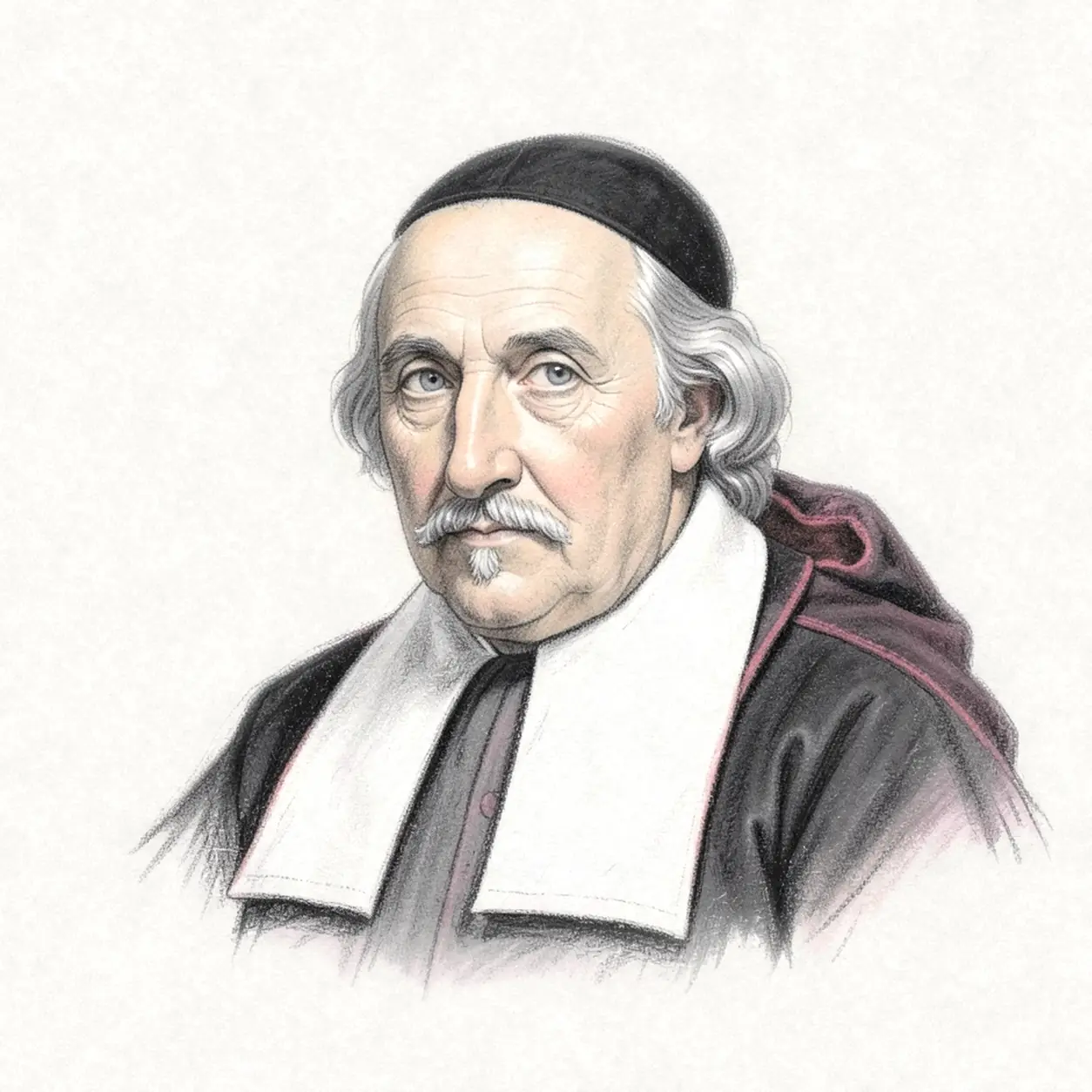
Saint François de Laval
Bishop · 1623-1708
Bishop of Quebec, missionary of New France, founder of the seminary
Saint François de Montmorency-Laval was the first bishop of Quebec. He came as vicar apostolic to New France in North America, and for almost fifty years he strengthened and built up the Church there. His memorial falls on May 6, the anniversary of his death.
He was born on April 30, 1623, at Montigny-sur-Avre, in the diocese of Chartres, into a noble family. At the age of nine he began his studies at the Jesuit college of La Flèche, and at nineteen he moved to the Collège de Clermont in Paris to study theology. After the deaths of his father and his two older brothers he became heir to the family estate. He was ordained a priest on May 1, 1647. As archdeacon of Évreux he visited the parishes and renewed them in the spirit of the Council of Trent.
In 1653 he was to go to Tonkin as vicar apostolic, but the plan failed because of Portuguese opposition. He then gave up the office of archdeacon, handed his estate over to his brother, and settled in Caen, at the hermitage led by Jean de Bernières, where he joined prayer with works of charity. At the request of King Louis XIV, Pope Alexander VII appointed him vicar apostolic of New France on June 3, 1658. He received episcopal ordination in Paris on December 8, and on June 16, 1659, he arrived in Quebec.
He found a colony of fewer than 2,500 people with only five parishes. In 1663 he founded the seminary of Quebec, which formed priests and became the heart of the Church there; Laval University later grew out of it. He sent priests, especially Jesuits, to new missions in Acadia, in the Great Lakes region, and in the Mississippi valley. In 1674 Quebec became a diocese, and he became its first bishop.
He was a man of prayer: after his early morning Mass he spent a long time in adoration of the Blessed Sacrament. He fought with all his strength against the trade in alcohol with the Indigenous peoples, which brought the colony income but ruined their lives and bred violence. In 1960 John XXIII stressed that he firmly defended the rights of the Indigenous peoples, even against the civil authorities.
Worn out by his labors, he resigned his office so that a younger bishop could take over the diocese. His successor, Jean-Baptiste de Saint-Vallier, changed some of his arrangements in the seminary, which Laval accepted with pain, yet he always showed his successor respect and obedience. In 1688 he returned to Quebec and lived in the seminary, devoting himself to prayer and to the care of the poor. He died on May 6, 1708, at the age of 85. His tomb is today in the Cathedral-Basilica of Notre-Dame de Québec.
John Paul II beatified him on June 22, 1980, together with Marie of the Incarnation and Kateri Tekakwitha. On April 3, 2014, Pope Francis declared him a saint by equivalent canonization, extending his cult to the whole Church. At the Mass of thanksgiving on October 12, 2014, he said of him and of Saint Marie of the Incarnation that they had, so to speak, founded the Church in Quebec.