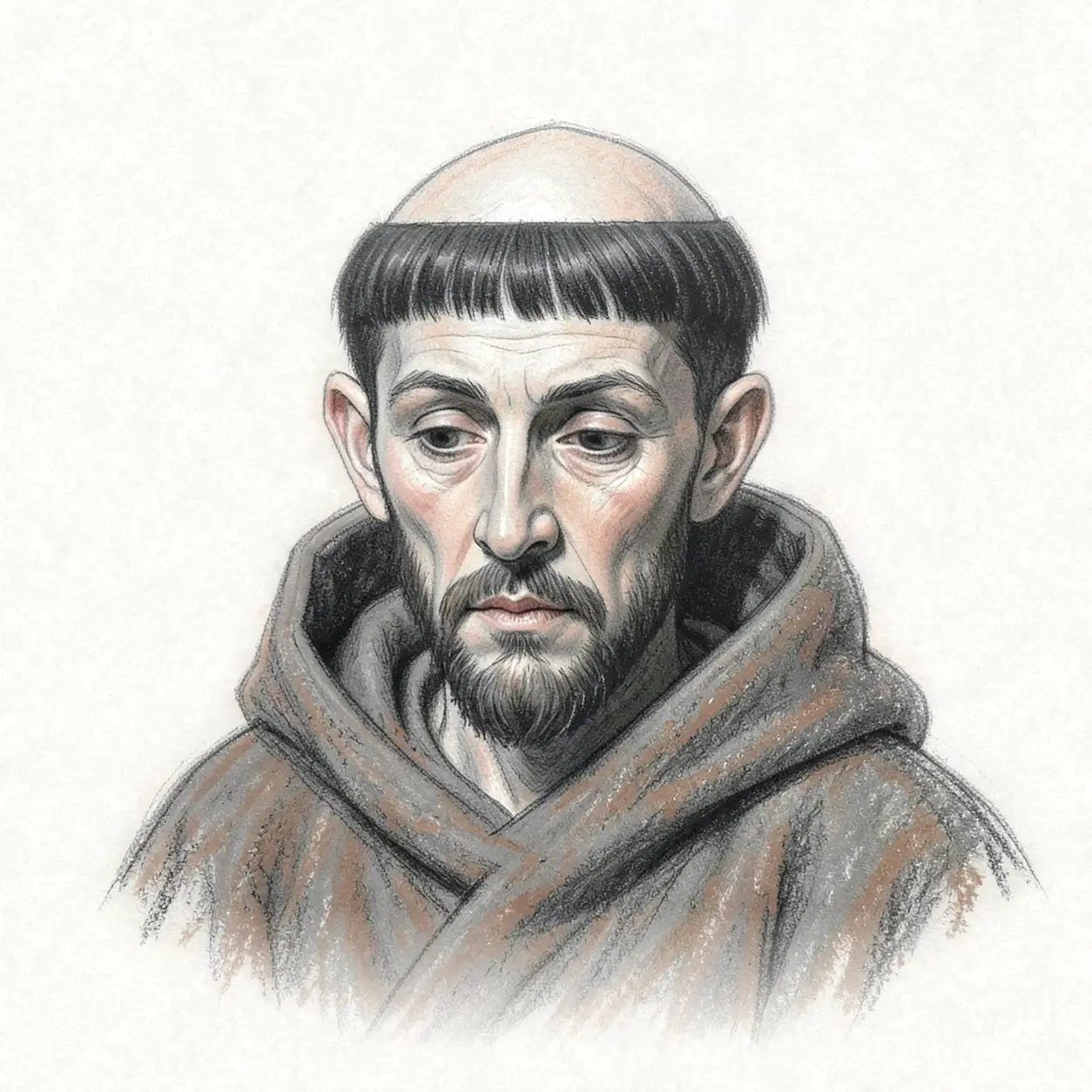
Saint Francis of Assisi
Friar · † 1226
Deacon, founder of the Order of Friars Minor, patron of Italy
Saint Francis of Assisi, known as the Poverello, was a deacon and the founder of the Order of Friars Minor. He left a life of comfort to imitate Christ in poverty and humility, and in the poor and the outcast he saw his brothers. He is one of the best-known and best-loved saints of the Church. His liturgical memorial falls on October 4.
He was born in Assisi in Umbria at the end of 1181 or the beginning of 1182, the son of the wealthy cloth merchant Pietro di Bernardone and of Pica. He spent a carefree youth, drawn by the ideals of chivalry. At the age of twenty he took part in the war between Assisi and Perugia, was taken prisoner, and fell ill. After his return home a slow change began in him.
To this period belong his meeting with a leper, whom Francis kissed, and his prayer before the crucifix in the abandoned little church of San Damiano, probably in 1205. There he heard the words: “Go, Francis, and repair my Church in ruins.” At first he took them literally and began to rebuild the chapel. When his father reproached him for giving too generously to the poor, Francis took off his clothes before the Bishop of Assisi and renounced his inheritance. From then on he lived as a hermit.
In 1208, listening to the Gospel of the sending out of the apostles, he understood that he was to live in poverty and preach the word of God. His first companions joined him, and in 1209 he went with them to Rome. Pope Innocent III received them kindly and approved their way of life. The brothers settled by the little church of Saint Mary of the Angels, called the Portiuncula. Saint Clare followed in Francis’s footsteps, and with her the order of the Poor Clares begins; in time a third order, for lay people, also arose. Pope Honorius III gave the Rule of the Friars Minor its final confirmation on November 29, 1223. Francis himself did not receive priestly ordination and remained a deacon to the end of his life.
In 1219, at the time of the Crusades, Francis reached Egypt and met Sultan Malik al-Kamil, who received him kindly. At Christmas 1223 in Greccio he prepared a manger with hay, an ox, and a donkey, at which Mass was celebrated; the tradition of the Christmas crèche goes back to this event. In 1224, at the hermitage on Mount La Verna, he received the stigmata, the marks of Christ’s Passion. Already gravely ill, he composed the Canticle of the Creatures, in which he praises God for all creatures.
He died on the evening of October 3, 1226, at the Portiuncula, lying on the bare ground, as he himself had wished. Two years later, in 1228, Pope Gregory IX proclaimed him a saint. Soon a basilica was built in Assisi, which holds his tomb and to which pilgrims still come in great numbers. In 1939 Pope Pius XII proclaimed him, together with Saint Catherine of Siena, principal patron of Italy, and in 1979 Saint John Paul II proclaimed him patron of those who promote ecology.