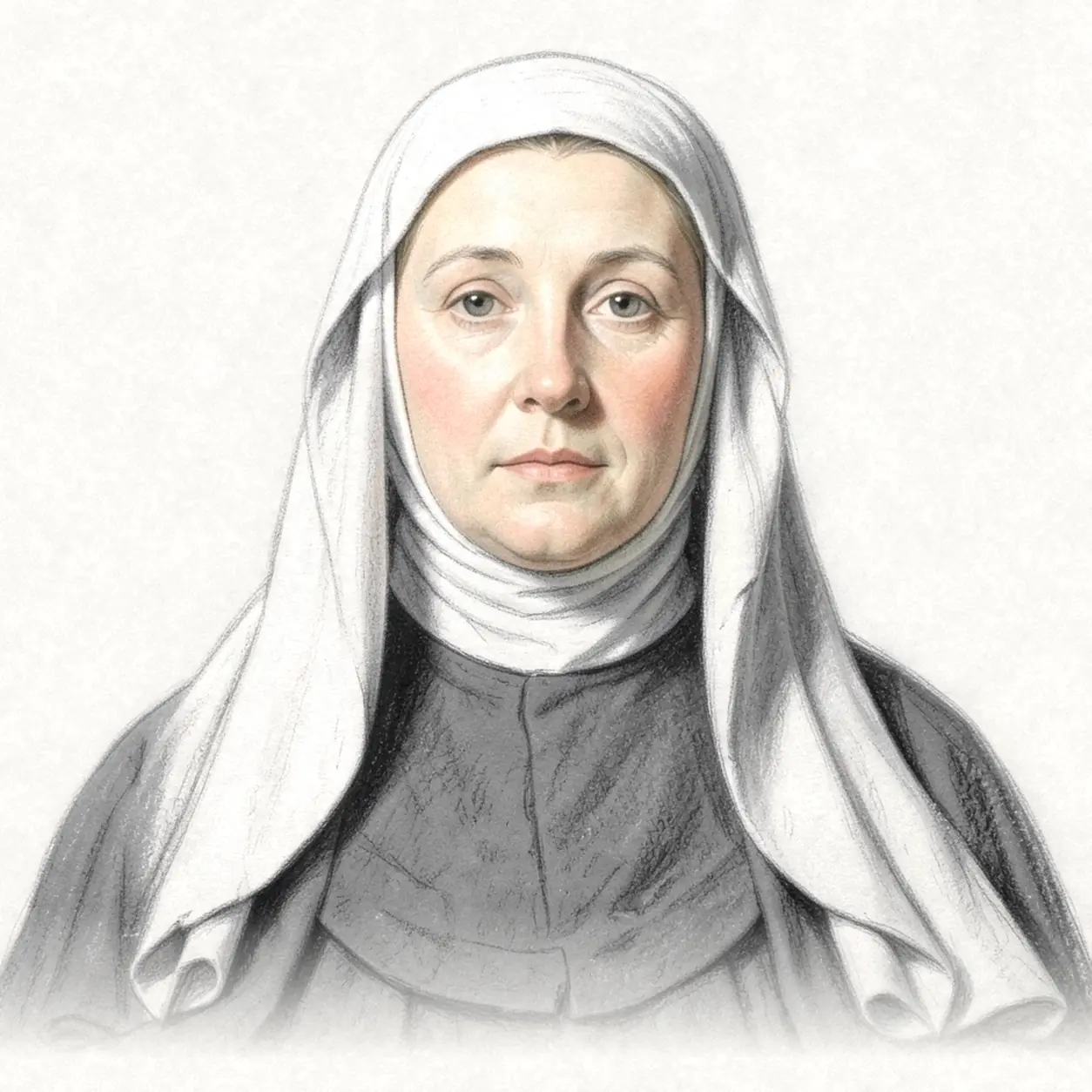
Saint Bridget of Sweden
Nun · 1303-1373
Religious, mystic, foundress of the Bridgettines, co-patroness of Europe
Saint Bridget of Sweden was a noblewoman, a wife and the mother of eight children, and after her husband’s death a mystic, a pilgrim, and the foundress of the Order of the Most Holy Savior, known as the Bridgettines. The Church commemorates her on July 23.
She was born in 1303 at Finsta, in the Swedish province of Uppland, into an aristocratic family. At the age of thirteen she was given in marriage to Ulf Gudmarsson, who governed an important district of the kingdom. The marriage lasted twenty-eight years, and eight children were born of it. One of her daughters, Catherine, is venerated as a saint.
The Roman Martyrology stresses that Bridget raised her children in the faith and by word and example led her husband, too, to piety. Together with Ulf she adopted the rule of the Franciscan tertiaries, gave generously to the poor, and founded a hospital. King Magnus summoned her to court to introduce his young wife, Blanche of Namur, to Swedish culture. In 1341 the couple made a pilgrimage to Santiago de Compostela.
Ulf died in 1344 in the Cistercian monastery of Alvastra. Bridget gave away her possessions to the poor and settled nearby. There the revelations began that were to accompany her for the rest of her life. Her confessors translated them from Swedish into Latin and gathered them in the eight books of the Revelations. The Church recognized Bridget’s holiness without pronouncing on her individual revelations. At that time, too, the plan matured for a new order made up of nuns and monks under the authority of an abbess. Its principal house later became the monastery at Vadstena.
In 1349 Bridget left Sweden for good and went to Rome to obtain papal approval for the rule. There, together with her daughter Catherine, she devoted herself to prayer, penance, and apostolic work. The popes were then residing in Avignon, and Bridget urgently called on them to return to Rome. She also wrote to rulers, urging peace between France and England. In 1370 Pope Urban V approved the rule of her order. At the turn of 1371 and 1372 she made her last pilgrimage, to the Holy Land.
She died in Rome on July 23, 1373, before Pope Gregory XI returned from Avignon for good. In 1374 her children Birger and Catherine brought her body to Vadstena, and on the way the funeral procession stopped in Gdańsk. At the end of the fourteenth century a monastery of Bridgettine nuns was founded there. King Władysław Jagiełło later brought sisters from Gdańsk to Lublin, where he had founded a church in thanksgiving for the victory at Grunwald.
Pope Boniface IX canonized Bridget on October 7, 1391. She is the patroness of Sweden, where both Catholics and Lutherans venerate her. John Paul II called her life and work a heritage that unites them. On October 1, 1999, he proclaimed her, together with Saint Catherine of Siena and Saint Teresa Benedicta of the Cross, co-patroness of Europe.