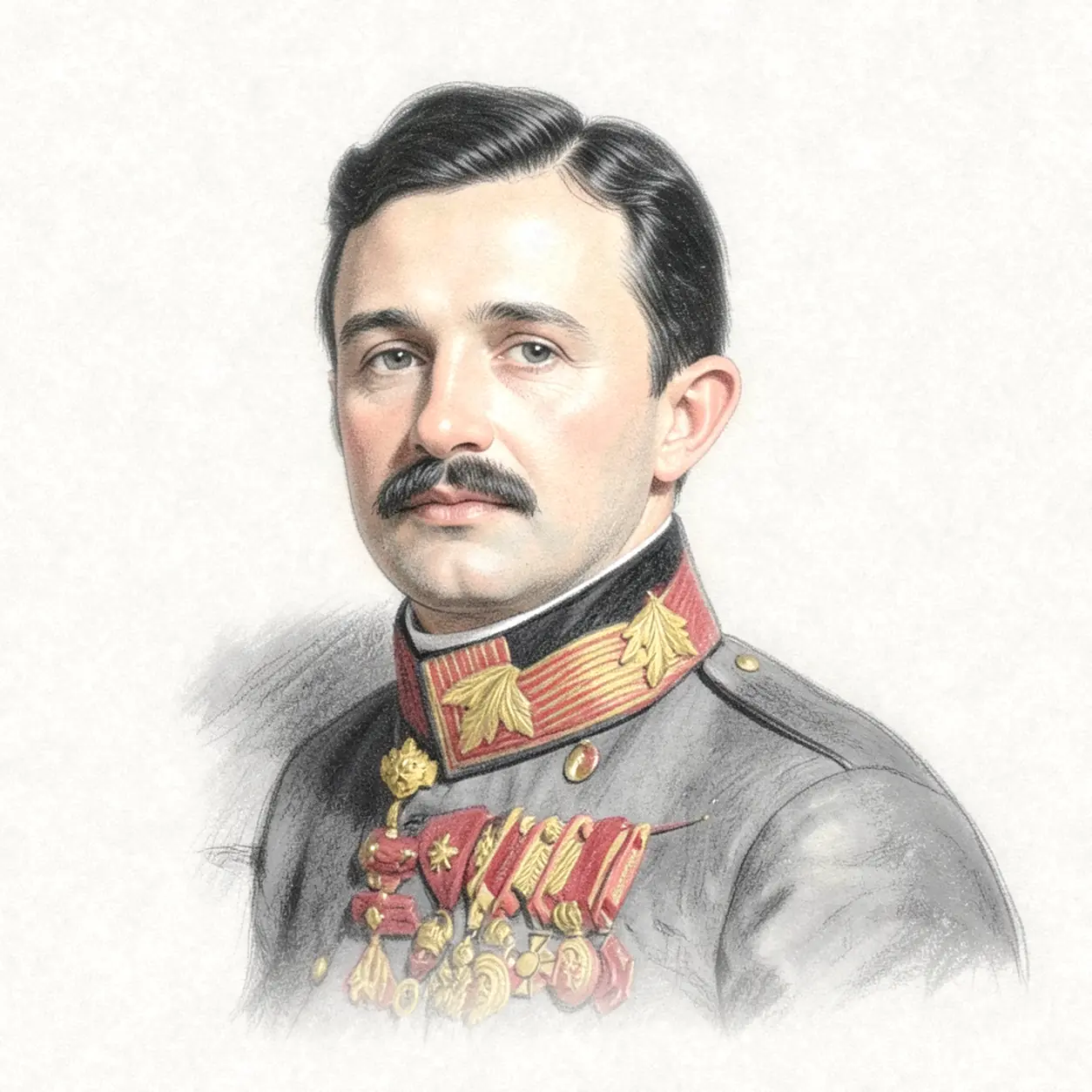
Blessed Charles of Austria
Royal · 1887-1922
Emperor of Austria and king of Hungary, husband and father, advocate of peace
Blessed Charles of Austria, who reigned as Charles I, was the last emperor of Austria and king of Hungary, a husband and the father of eight children. His memorial falls on October 21, the anniversary of his wedding to Zita of Bourbon-Parma.
He was born on August 17, 1887, at Persenbeug Castle in Lower Austria, the son of Archduke Otto and Princess Maria Josepha of Saxony. Emperor Franz Joseph I was his great-uncle. He received a Catholic upbringing, studied at the Schottengymnasium in Vienna, and at the age of sixteen became an officer in the imperial army. From his youth he was devoted to the Eucharist and to the Sacred Heart of Jesus, and he made important decisions in prayer.
He married Princess Zita of Bourbon-Parma on October 21, 1911. On the eve of the wedding he told her that from then on they were to help each other on the way to heaven. They had eight children. When his uncle, Archduke Franz Ferdinand, was killed in an assassination on June 28, 1914, Charles became heir to the throne.
He became emperor of Austria on November 21, 1916, after the death of Franz Joseph, in the middle of the First World War, and on December 30 he was crowned apostolic king of Hungary. He understood his authority as service to the peoples entrusted to him. He regarded war as something appalling and worked for peace, supporting the peace initiative of Pope Benedict XV, though without success. He also tried to ease the hardship of the population: he opened kitchens for the poor and, guided by the encyclical Rerum novarum, set up an office for social affairs and introduced social legislation.
After the defeat in 1918 he withdrew from taking part in government, and so the transition to a new order took place without civil war. Yet he did not abdicate, because he regarded his authority as a task entrusted to him by God. Banished from his homeland, he settled with his family in Switzerland. In 1921 he twice tried to return to the Hungarian throne, but both attempts failed, because he would not allow fratricidal fighting. He was then exiled to Madeira.
In Funchal he lived with his family in poverty, in a damp house, and fell gravely ill with pneumonia. He accepted his illness as a sacrifice for the peace and unity of his peoples, and he forgave those who had wronged him. He died on April 1, 1922, at the age of 34, with his eyes fixed on the Blessed Sacrament and the name of Jesus on his lips. Before his death he repeated that he had always tried to know God’s will as clearly as possible and to carry it out as perfectly as possible.
The Archbishop of Vienna took up the cause of his beatification, and the informative process lasted from 1949 to 1954. In 2003 the decrees on his heroic virtues and on a miracle were promulgated. Pope John Paul II beatified Charles on October 3, 2004, in Saint Peter’s Square and held him up as an example especially for those who bear political responsibility in Europe. After the emperor’s death the League of Prayer of Emperor Charles for Peace among the Peoples came into being, and the Church recognized it in 1963.