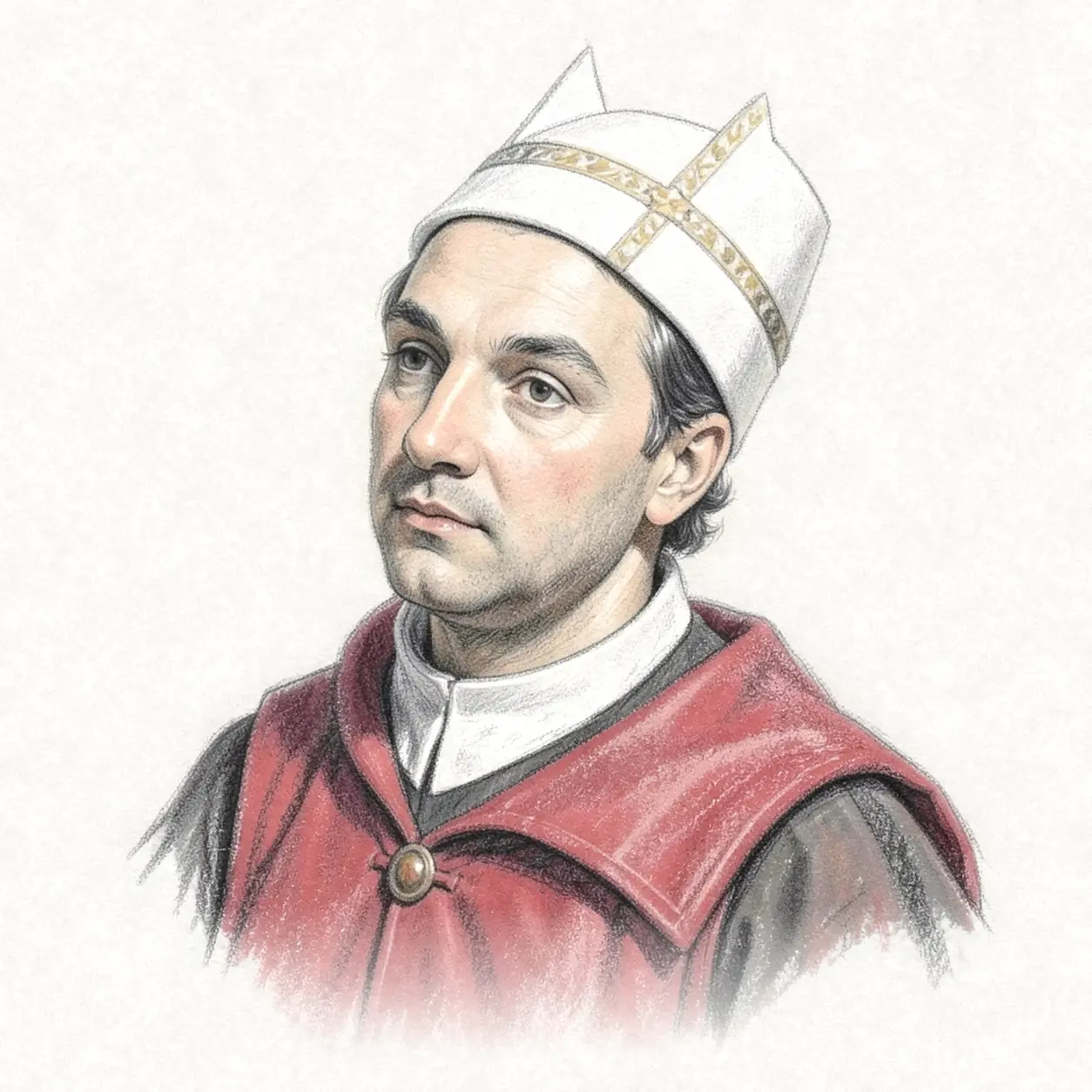
Blessed Bartholomew of Breganze
Bishop
Bishop, Dominican, founder of the Militia of Jesus Christ
Blessed Bartholomew of Breganze, also called Bartholomew of Vicenza, was a Dominican, preacher, and theologian, and later a bishop: first of Limassol in Cyprus, then of his native Vicenza. He lived in the 13th century. The Roman Martyrology commemorates him on October 27.
Little is known about his youth. He was born in Vicenza around the year 1200; the exact date is not certain. Tradition traces his descent from a powerful family of nearby Breganze, yet he himself signed his name as Bartholomew of Vicenza, and historians call this origin into doubt. According to tradition he studied in Padua, entered the Order of Preachers there, and received the habit from the hands of Saint Dominic himself.
He preached in the cities of northern Italy, torn by the strife of factions and by heresies, and he worked to reconcile those at odds. In 1233 he founded the Militia of Jesus Christ, a military order for lay people, including the married, who bound themselves to defend the Catholic faith and the liberty of the Church. Its rule, written for the knights of Parma, was approved by Pope Gregory IX. This is the work the Martyrology names beside his name. Later Bartholomew taught theology at the papal curia.
In 1252 Pope Innocent IV appointed him bishop of Limassol in Cyprus. From there Bartholomew visited in the Holy Land the king of France, Louis IX, the future saint, who was staying there with a crusade; a friendship grew between them. At the end of 1255 Pope Alexander IV transferred him to the episcopal see of Vicenza. The city, however, was ruled by Ezzelino da Romano, remembered as a tyrant, and the bishop was able to take possession of his diocese only after Ezzelino’s death in 1259.
He also went to England as an envoy of the pope. On his way back he stopped in Paris to see Louis IX, and the king gave him a relic of the Holy Cross and a thorn from Christ’s crown of thorns. In 1260 Bartholomew brought them to Vicenza, and that same year he began to build for them the church of Santa Corona, that is, of the Holy Crown, with a Dominican convent. He rebuilt the diocese after years of turmoil and worked for peace among the quarreling cities.
In 1267 he preached in Bologna at the solemn translation of the relics of Saint Dominic. He left collections of sermons, among them sermons on the Blessed Virgin Mary, and commentaries on Sacred Scripture. He died in Vicenza. The year of his death is not certain: some sources give 1270, others July 1, 1271. He was buried in the church of Santa Corona, where his remains rest to this day.
The faithful venerated him from the moment of his death. This veneration was confirmed by Pope Pius VI on September 11, 1793. The memorial of the blessed is kept by the Dominicans and by the Church in Vicenza. The reliquary of the Holy Thorn is kept today in the Diocesan Museum there.