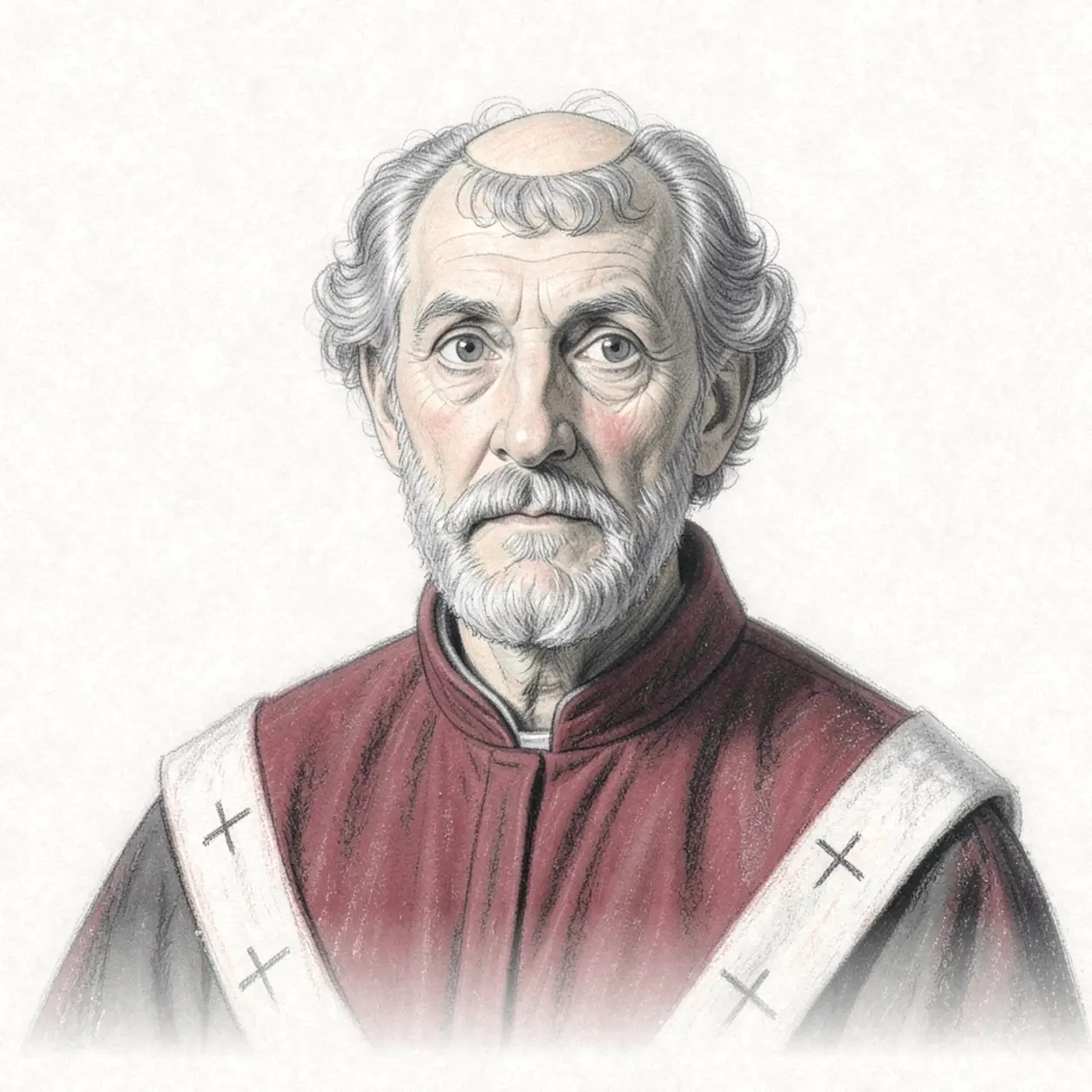
Saint Willibrord
Bishop · 658-739
Bishop, apostle of the Frisians, founder of the abbey of Echternach
Saint Willibrord was an Anglo-Saxon monk and missionary, the first bishop of Utrecht and the founder of the abbey of Echternach. He is called the apostle of the Frisians. The Church commemorates him on November 7.
He was born in 658 in Northumbria, in the north of England. His father, Wilgils, who later became a hermit himself, gave him as a small child to the abbey of Ripon, then governed by Saint Wilfrid. There Willibrord became a monk. At the age of twenty he left for Ireland, for the monastery of Rathmelsigi, where for twelve years he studied under Saint Egbert and was ordained a priest.
In 690 he set out with eleven companions for the Continent to preach the Gospel to the pagan Frisians in the lands of today’s Netherlands. He found support in Pepin of Herstal, mayor of the palace and effective ruler of the Franks, who had taken the southern part of Frisia. Willibrord also cared about the bond with Rome. Twice he went to Pope Saint Sergius I: first for a blessing and a mandate for missionary work, and then, sent by Pepin, for episcopal consecration.
In November 695 the pope ordained him archbishop of the Frisians in the Roman basilica of Saint Cecilia, gave him the name Clement, and conferred the pallium on him. Utrecht became Willibrord’s episcopal see, and there he built a cathedral dedicated to the Savior. For years he traveled through the country, preached the word of God, baptized, built churches and monasteries, and appointed further bishops from among his companions. He also reached Denmark.
In 698, on land given by Saint Irmina, abbess of the convent of Oeren in Trier, and with Pepin’s support, he founded the abbey of Echternach, in today’s Luxembourg. He would return there to gather strength for further work in the quiet of the monastery. After Pepin’s death the pagan ruler of the Frisians, Radbod, regained the lands he had lost, destroyed churches, and persecuted the missionaries. Willibrord was able to return only after Radbod’s death in 719. For three years Saint Boniface, the future apostle of Germany, helped him rebuild the ruined work.
Saint Bede the Venerable, who in 731 was completing his history of the Church in England, wrote of him as an aged bishop still living, who had held his office for thirty-six years. Willibrord died on November 7, 739, at Echternach, at the age of eighty-one, and was buried in the abbey he had founded.
He was venerated as a saint from the time of his death, long before the papal canonization procedure existed, and his tomb drew pilgrims from the beginning. Every year on the Tuesday after Pentecost a dancing procession in his honor, known since the Middle Ages and inscribed in 2010 on the UNESCO list of intangible cultural heritage, passes through Echternach. John Paul II, who prayed at his tomb in 1985, called him a herald of the faith in northwestern Europe and the founder of the Church in the Netherlands.