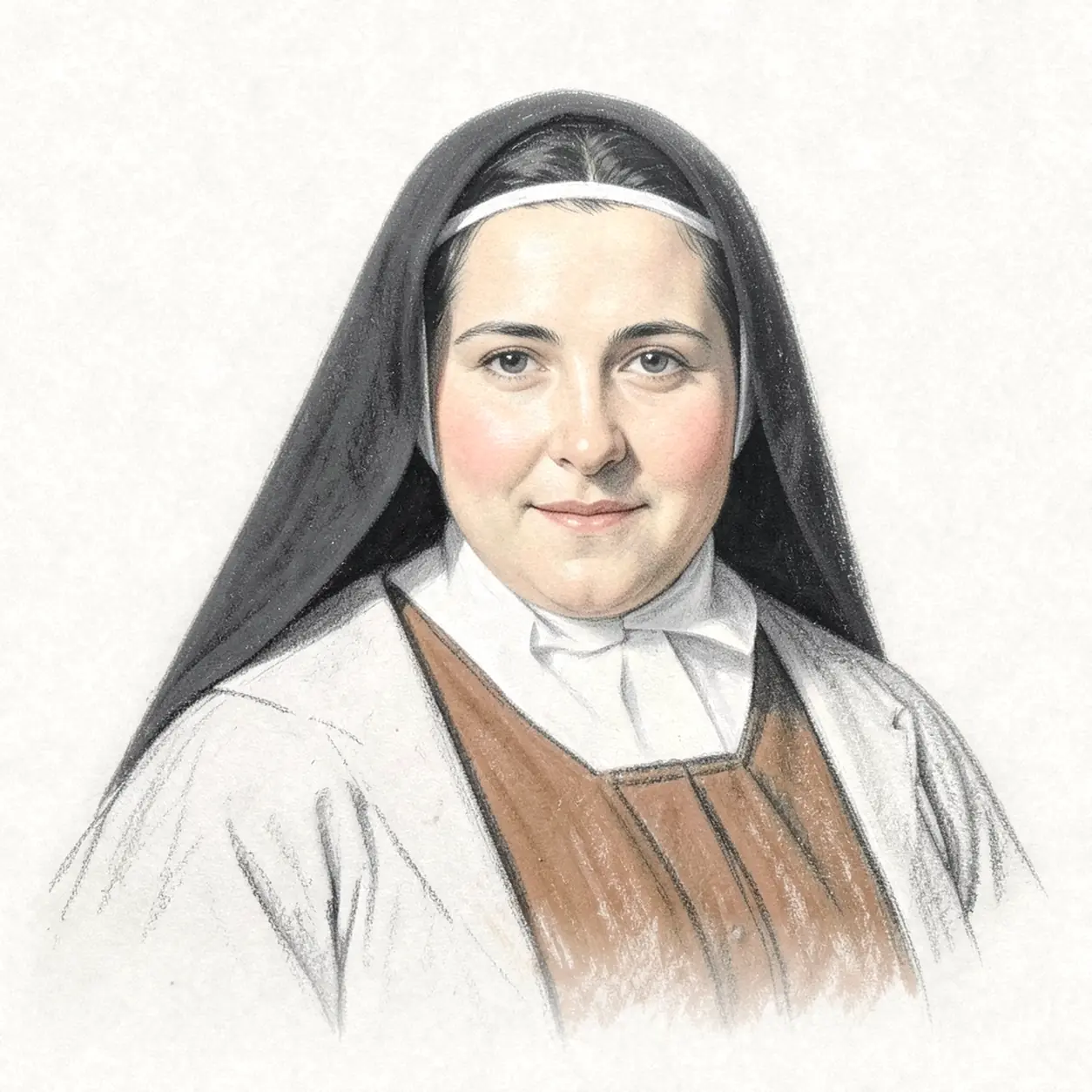
Saint Thérèse of the Child Jesus
Nun · 1873-1897
Virgin, Carmelite, Doctor of the Church, patroness of the missions
Saint Thérèse of the Child Jesus and the Holy Face, also known as Thérèse of Lisieux, was a French Discalced Carmelite nun and is a Doctor of the Church. She lived only twenty-four years, nine of them in the enclosure of Carmel, and after her death she became one of the best-known and best-loved saints. Her liturgical memorial falls on October 1.
She was born on January 2, 1873, in Alençon in Normandy, the youngest of the nine children of Louis and Zélie Martin, whom the Church also venerates as saints. Four of her siblings died in childhood, and all five daughters chose religious life. Her mother died on August 28, 1877, when Thérèse was four years old, and her father moved with his daughters to Lisieux. As a child Thérèse fell seriously ill; she attributed her healing on Pentecost Sunday 1883 to Mary and called it “the smile of Our Lady.”
She regarded Christmas 1886 as the turning point and called it her “complete conversion”: she then overcame her childhood oversensitivity. She longed to enter the Carmel of Lisieux, where two of her sisters already were, but she was too young. During a pilgrimage to Rome, at an audience on November 20, 1887, she asked Pope Leo XIII himself for permission. She entered the monastery on April 9, 1888, at the age of fifteen. She wanted, as she wrote, “to save souls and to pray for priests.” She made her religious profession on September 8, 1890.
She suffered deeply over the illness of her father, who died on July 29, 1894. In Carmel she discovered the “little way” of spiritual childhood and taught it to the novices entrusted to her. It is a way of trust and love: it does not consist in great deeds but in fidelity in everyday, seemingly unimportant things and in entrusting oneself to God as a child entrusts itself to its father. On the feast of the Most Holy Trinity, June 9, 1895, Thérèse made her Act of Oblation to Merciful Love. Living in the enclosure, she supported with her prayer and her letters missionaries whom she called her brothers.
On the night between Holy Thursday and Good Friday 1896 the first symptoms of tuberculosis appeared. At the same time a painful trial of faith began, which lasted until the end of her life; Thérèse offered it for unbelievers. In her last years, at the request of her superiors and of one of her sisters by blood, she wrote down memories and reflections, preserved in three manuscripts. She died on September 30, 1897, in the Carmel of Lisieux with the words “My God, I love you” on her lips.
A year later Story of a Soul, based on her manuscripts, was published; the book was quickly translated into many languages. Pope Pius XI beatified Thérèse on April 29, 1923, and canonized her on May 17, 1925, and on December 14, 1927, he proclaimed her, together with Saint Francis Xavier, patroness of the missions. In 1944 Pius XII numbered her among the patronesses of France. Saint John Paul II proclaimed her a Doctor of the Church on October 19, 1997.