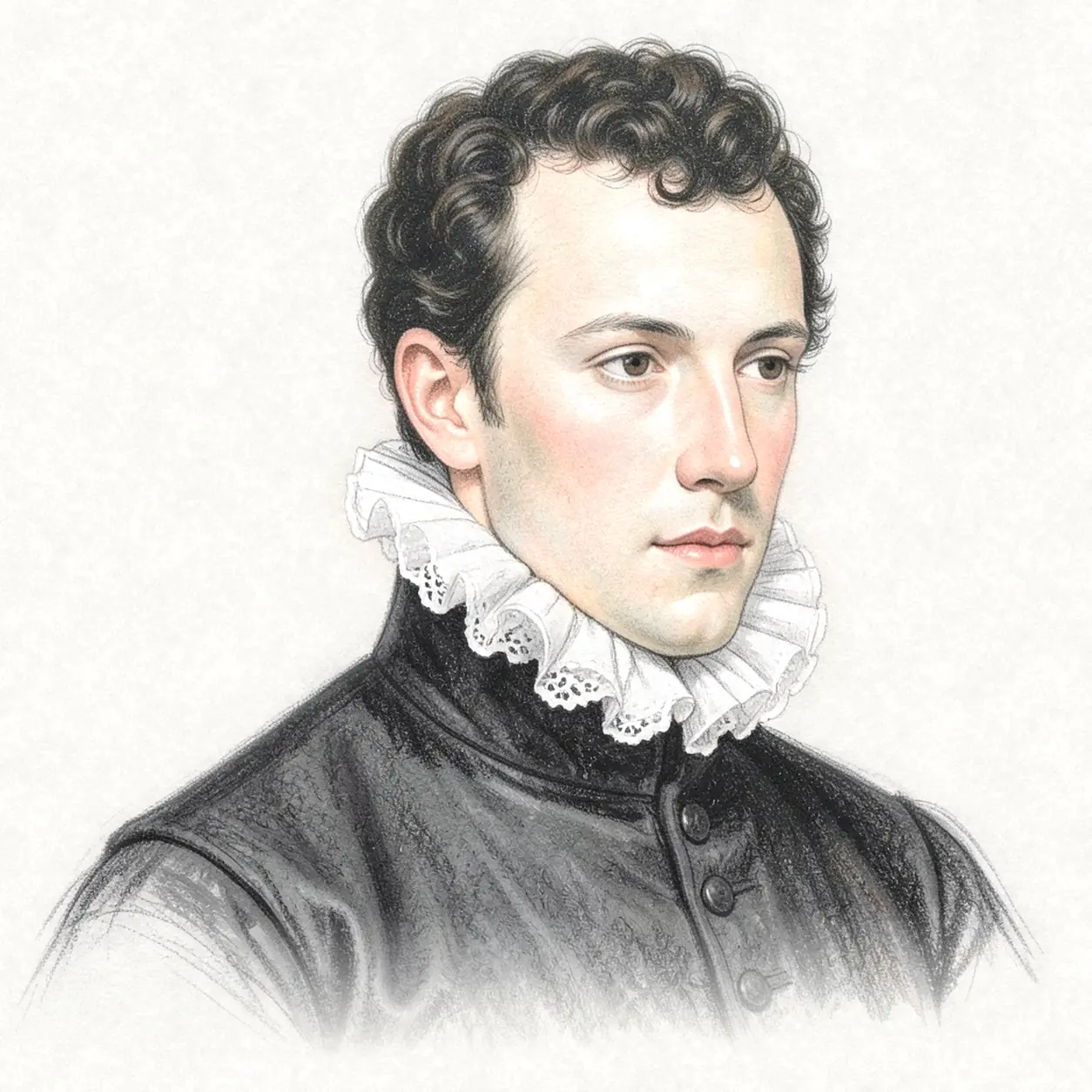
Saint Philip Howard
Martyr · 1557-1595
Martyr, earl of Arundel, husband and father, prisoner in the Tower of London
Saint Philip Howard, Earl of Arundel, was an English nobleman, a husband and father, who after embracing the Catholic faith spent more than ten years in the Tower of London and died there. He is one of the Forty Martyrs of England and Wales. The Church commemorates him on October 19.
He was born on June 28, 1557, in London, the son of Thomas Howard, Duke of Norfolk. His godfather was King Philip II of Spain, the husband of Queen Mary Tudor. He was nevertheless brought up as a Protestant. In 1572 his father was beheaded by order of Queen Elizabeth I. Philip studied at Cambridge and, while still a boy, was married to Anne Dacre. In 1580 he inherited from his maternal grandfather the title of Earl of Arundel.
At the court of Elizabeth I he enjoyed the queen’s favor in his youth and led a life far from the faith, and for a time he also neglected his wife. The turning point began in 1581, when in the Tower he listened to the disputation of an imprisoned Jesuit, Saint Edmund Campion, with Anglican theologians. He was reconciled with his wife, who had herself already become a Catholic, and on September 30, 1584, the Jesuit William Weston received him into the Catholic Church.
In April 1585 he decided to leave England in order to practice his faith freely abroad. The ship was stopped at sea and the earl was confined in the Tower. He was sentenced to a fine of ten thousand pounds and to imprisonment for as long as the queen pleased. After the defeat of the Spanish Armada he was put on trial again, accused of having prayed for the victory of the invaders. A death sentence was passed, which was never carried out.
In prison he gave many hours each day to prayer and penance. Over the fireplace of his cell in the Beauchamp Tower he carved a Latin sentence that can still be seen there today: “Quanto plus afflictionis pro Christo in hoc saeculo, tanto plus gloriae cum Christo in futuro,” that is: the more affliction for Christ in this world, the more glory with Christ in the next. He never saw his son, who was born after his imprisonment. When toward the end of his life he asked to see his wife and son, he was told that the condition was to attend an Anglican service, after which he would also regain his freedom. He refused.
He died in the Tower on October 19, 1595, at the age of 38, worn out by want and the hardships of prison. Although he did not die on the scaffold, the Church venerates him as a martyr. He was buried in the chapel of Saint Peter ad Vincula in the Tower, and in 1624 his widow took his remains from there, and they were laid to rest at Arundel.
Pius XI beatified him on December 15, 1929. Paul VI canonized him on October 25, 1970, together with thirty-nine other martyrs of England and Wales, and in his homily quoted his words: he was sorry to have only one life to give for this noble cause. Since 1971 his relics have rested in the cathedral at Arundel, which is dedicated to Our Lady and Saint Philip Howard.