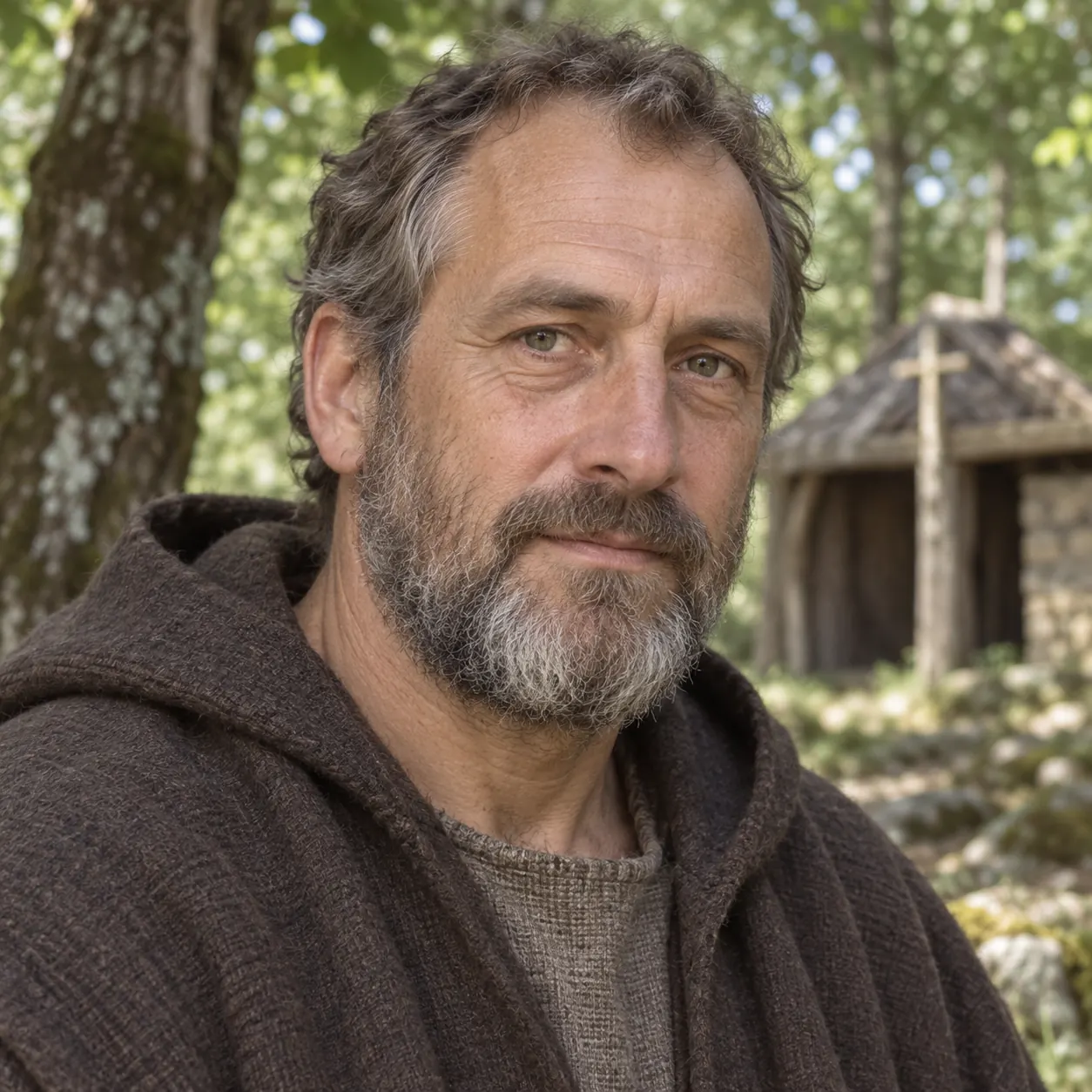
Saint Leonard of Noblac
Hermit
Hermit of Noblac near Limoges, patron saint of prisoners
Saint Leonard of Noblac, also called Leonard of Limoges, was a hermit who, according to tradition, lived in the 6th century near Limoges in France. Little is known about his life, and yet in the Middle Ages he was among the most venerated saints of Europe. He is the patron saint of prisoners. The Church commemorates him on November 6.
The Roman Martyrology speaks of him in a single sentence: at Noblac, near Limoges in Aquitaine, Saint Leonard, hermit. The earliest mentions come only from the 11th century: around 1028 the chronicler Ademar of Chabannes wrote about him, and around 1030 his Life was composed. Historians do not consider it reliable, yet everything that is told about the saint comes from it.
According to this Life, Leonard was born in Gaul at the turn of the 5th and 6th centuries, into a noble Frankish family. King Clovis is said to have been his godfather, and Saint Remigius, bishop of Reims, his teacher. Leonard obtained from the king the right to free the prisoners he came upon, and he restored freedom to many of them. He declined the office of bishop, stayed in the monastery of Micy near Orléans, and then settled alone in a forest not far from Limoges.
Tradition relates that when the king was hunting in that region, the queen, who was with him, went into labor, and the birth was difficult. Through Leonard’s prayer she was safely delivered of a child, and the grateful ruler gave the hermit a part of the forest. There Leonard built a chapel in honor of the Mother of God and named the place Nobiliacum. The sick and freed prisoners came to him, and many settled nearby. In this way, it is said, the settlement arose that is today Saint-Léonard-de-Noblat.
Leonard is said to have died on November 6. The year of his death is unknown, and the mid-6th-century dates sometimes given are only conjecture. His tomb is in the Romanesque collegiate church of Saint-Léonard-de-Noblat, inscribed on the UNESCO World Heritage List as part of the Routes of Santiago de Compostela in France.
From the 11th century on, devotion to him spread across Europe: through France, England, Italy, and Germany, especially Bavaria, and also through Bohemia and Poland. Hundreds of churches and chapels were dedicated to him. In the time of the Crusades captives called on him. Bohemond, prince of Antioch and one of the leaders of the First Crusade, attributed his release from captivity in 1103 to the saint’s intercession, and after his return he laid silver fetters at his tomb. Art depicts Leonard with a chain in his hand. Women expecting a child also call on him, and in the Alpine countries farmers entrust their horses and cattle to him.
Leonard was not canonized in the present-day sense: his cult became established at a time when the proclamation of saints was not yet reserved to the pope, and the Church confirms it by his entry in the Roman Martyrology. In Poland his name is borne by the Romanesque crypt of Wawel Cathedral in Krakow. There, on November 2, 1946, Father Karol Wojtyła, the future Pope John Paul II, celebrated his first Holy Mass.