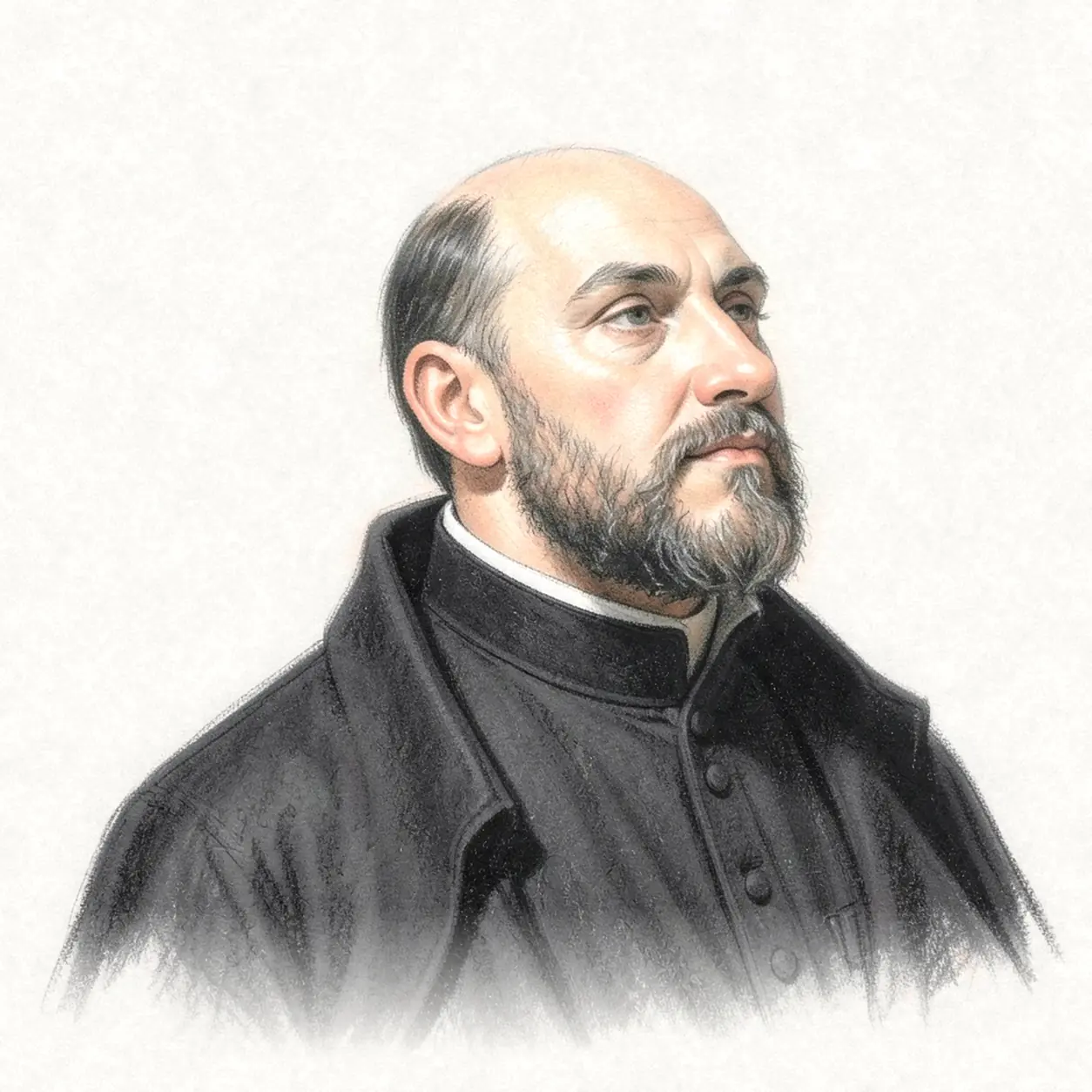
Saint John Leonardi
Priest · 1541-1609
Priest, founder of the Clerics Regular of the Mother of God, patron of pharmacists
Saint John Leonardi was an Italian priest from the region of Lucca who gave up the trade of an apothecary for the priesthood. He founded the Order of Clerics Regular of the Mother of God, reformed religious communities on behalf of the Holy See, and helped to bring into being the missionary work of Propaganda Fide. His liturgical memorial falls on October 9.
He was born in 1541 at Diecimo near Lucca, the youngest of seven children. When he was seventeen, his father sent him to Lucca to learn the apothecary’s trade. After about ten years John obtained the right to open his own pharmacy, but at that point he decided to carry out a plan he had long held in his heart and to prepare for the priesthood. He was ordained a priest in December 1571 and celebrated his first Mass on the feast of the Epiphany in 1572.
As a priest he devoted himself above all to teaching the catechism to children. His way of teaching bore such fruit that the bishop of Lucca extended it to all the churches of the city, and John gathered lay helpers in the Confraternity of Christian Doctrine. On September 1, 1574, together with a group of young men, he founded at the church of Santa Maria della Rosa in Lucca the Congregation of Reformed Priests of the Blessed Virgin, later called the Order of Clerics Regular of the Mother of God. He often repeated that it is necessary to start afresh from Christ.
The new community met strong opposition in Lucca. Under pressure from the authorities of the Republic of Lucca, during one of John’s stays in Rome, he was forbidden to return to his home city, and the inquiry he himself had requested did not change the situation. In Rome he met Saint Philip Neri and grew close to him. In 1596 Pope Clement VIII entrusted him with the reform of the Benedictine congregation of Montevergine, and in 1601 John carried out a similar reform among the Vallombrosans. In May 1605 he sent the newly elected Pope Paul V a memorial on the renewal of the Church, which in his view had to begin with those who govern.
Together with the Spanish prelate Juan Bautista Vives and the Jesuit Martín de Funes, in 1607 and 1608 he drew up a plan for a congregation and a seminary for priests who were to proclaim the faith to peoples who did not yet know it. According to the Roman Martyrology, he laid the foundations in Rome for the College of the Propagation of the Faith. He died in Rome on October 9, 1609, of influenza, which he caught while caring for the sick during an epidemic in the Campitelli district. His relics rest in the Roman church of Santa Maria in Campitelli.
Pius IX beatified him in 1861, and Pius XI canonized him on April 17, 1938, on the same day as Saint Andrew Bobola. On August 8, 2006, he was proclaimed patron of pharmacists. In 2009, on the 400th anniversary of his death, Benedict XVI pointed to him as a model for priests and summed up his program in the words “Either Christ or nothing.”