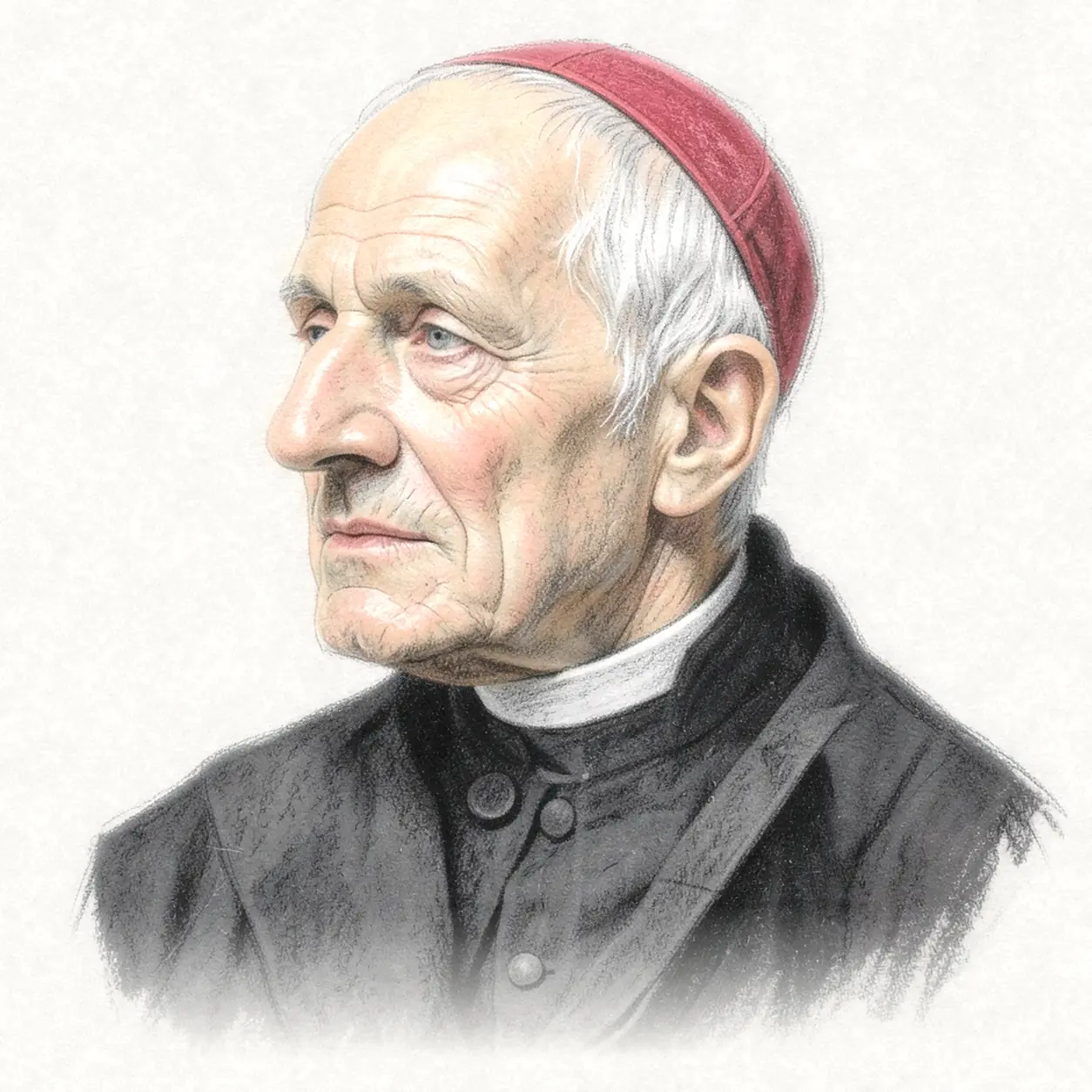
Saint John Henry Newman
Priest · 1801-1890
Priest and Doctor of the Church, cardinal, founder of the Oratory in England
Saint John Henry Newman was an English theologian and preacher. An Anglican clergyman, he became a Catholic in 1845, joined the Oratorians, and late in life was made a cardinal. He is a Doctor of the Church. His liturgical memorial falls on October 9, the anniversary of his reception into the Catholic Church.
He was born in London on February 21, 1801, the eldest of the six children of a banker. In 1816 he experienced a conversion in which, as he himself said, his whole journey had its beginning. At that time he embraced evangelical Protestantism and held the pope to be the Antichrist. In 1822 he became a fellow of Oriel College, Oxford, in 1825 he was ordained a priest in the Church of England, and from 1828, as vicar of the university church of Saint Mary the Virgin, he became famous for his sermons.
In 1832 and 1833 he traveled around the Mediterranean, and during that journey he wrote the prayer in verse “Lead, Kindly Light.” After his return he became one of the leaders of the Oxford Movement, which sought to resist religious liberalism and to restore to the Church of England the heritage of the ancient Church. Yet his study of the Fathers of the Church drew him ever closer to Catholicism.
In 1842 he settled with friends at Littlemore, near Oxford. There he worked on a treatise on the development of Christian doctrine, in which he showed that over the centuries the Church comes to understand the same faith ever more deeply. On October 9, 1845, Blessed Dominic Barberi, an Italian Passionist, received him into the Catholic Church. Many friends then turned away from him.
In 1847 he was ordained a priest in Rome and chose the way of the Oratorians of Saint Philip Neri. In England he founded the first community of the Oratory, which settled at Edgbaston in Birmingham; as a pastor there he visited the sick, the poor, and prisoners. In the 1850s he was rector of the Catholic University in Dublin, and his lectures gave rise to the book “The Idea of a University.”
As a Catholic he often met with suspicion; the apostolic letter for his beatification says that he bore it patiently. In 1864 he published his autobiography, “Apologia pro Vita Sua,” and in 1870 the “Grammar of Assent,” a work on the act of faith. The Catechism of the Catholic Church quotes his words on conscience as the aboriginal Vicar of Christ. In 1879 Leo XIII made him a cardinal, and Newman chose as his motto “Cor ad cor loquitur,” “Heart speaks unto heart.”
He died at Edgbaston on August 11, 1890. In accordance with his wish, the words “Ex umbris et imaginibus in veritatem,” “Out of shadows and images into the truth,” were inscribed on his gravestone. Benedict XVI beatified him in Birmingham on September 19, 2010, and Pope Francis canonized him on October 13, 2019. On November 1, 2025, Leo XIV proclaimed him a Doctor of the Church and co-patron, with Saint Thomas Aquinas, of the Church’s educational mission.