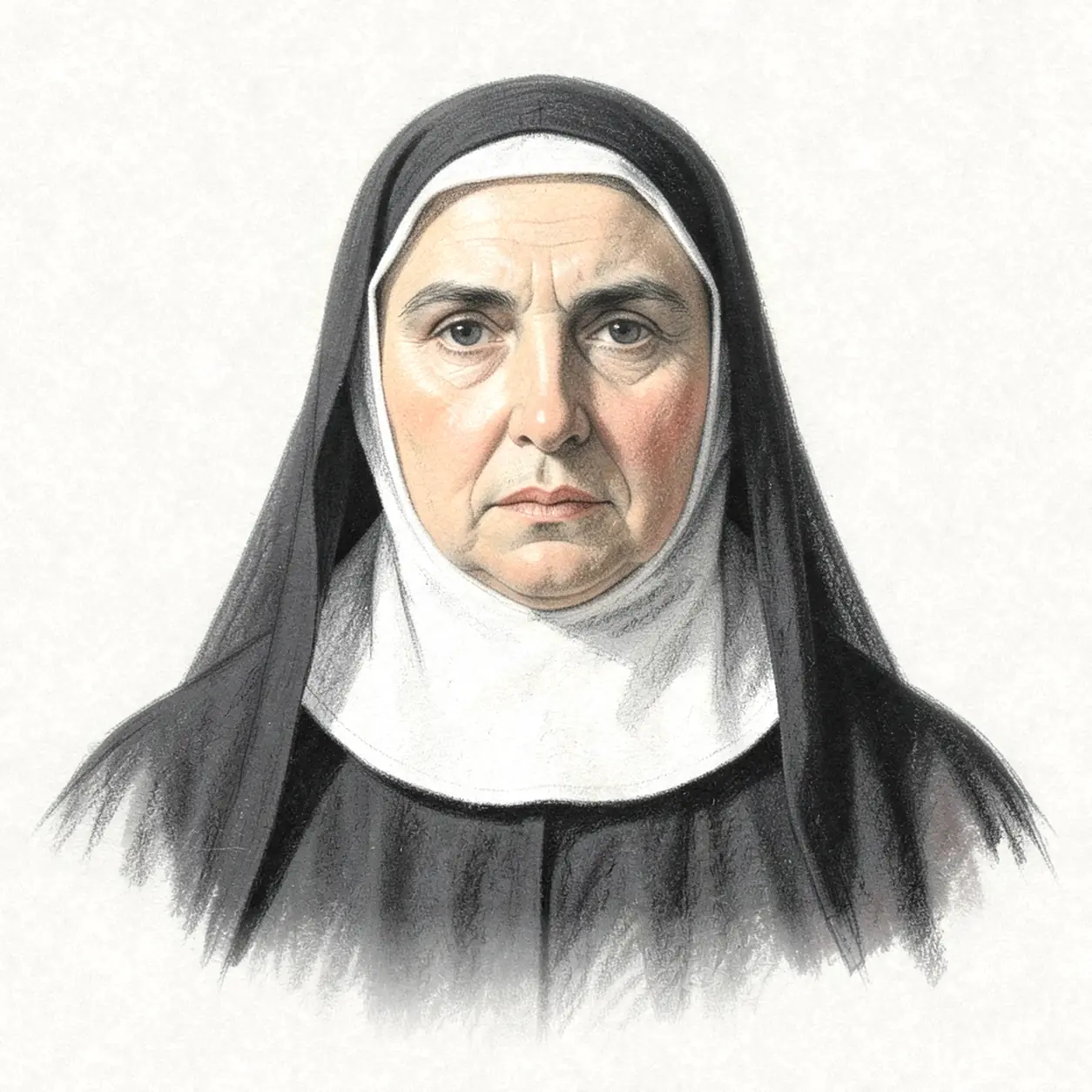
Saint Joaquina de Vedruna
Nun · 1783-1854
Mother of a family, widow, foundress of the Carmelite Sisters of Charity
Saint Joaquina de Vedruna was a wife and the mother of nine children, and as a widow she founded the Congregation of the Carmelite Sisters of Charity, devoted to caring for the sick and educating girls. The Roman Martyrology commemorates her on August 28, the day of her death.
She was born on April 16, 1783, in Barcelona, into a noble family. At the age of twelve she wanted to enter the Carmelite nuns, but she was not accepted because of her age. Her father chose as her husband Teodoro de Mas, a lawyer ten years older than she, who had himself once desired religious life but had been unable to embrace it. They were married in 1799.
In a happy marriage she ran the household and visited the sick in the hospitals. She bore nine children, several of whom died in childhood, and taught them to pray and to be generous to the poor. During the war against Napoleon her husband went off to fight, and she had to flee with the children before the troops. In 1816 Teodoro died; Joaquina, herself gravely ill at the time, could not be with him at the end. The bull of canonization relates that she then heard the Crucified call her to belong to him alone from then on.
As a widow she moved with her children to Vic, to the family estate. She took the habit of a Franciscan tertiary, lived simply, and continued to serve the sick. She also provided for her children’s future: she helped her son find an occupation, and she arranged marriages for her daughters or entrusted them to relatives and convents. The priest Esteban Fábregas advised her to found a new community for the sick and for the education of girls, and the bishop of Vic promised his help if she placed it under the protection of Our Lady of Mount Carmel. On February 26, 1826, Joaquina began community life in her house in Vic with her first companions.
The sisters taught poor girls and nursed the sick in hospitals and homes, and further houses were founded in Catalonia. In 1834, during the civil war, Joaquina was imprisoned and mistreated, and later she had to flee with her sisters to France, where she stayed for about three years in Perpignan. In time the bishops placed a director general over the congregation, which limited her authority; the bull notes that she herself had asked God for a hidden life.
In 1849, while visiting her daughters, Cistercian nuns at Vallbona, she suffered a paralysis of one side of her body, but she recovered her strength. In 1852 further strokes took away the use of her limbs and her speech. When a cholera epidemic broke out, which also took the lives of several sisters, she offered her life to God for others. She died of cholera on August 28, 1854, in a public hospital in Barcelona, poor among the poor.
Pius XII beatified her in 1940, and John XXIII canonized her on April 12, 1959, together with Saint Charles of Sezze; it was the first canonization of his pontificate. In the bull of canonization the pope held her up as a model for virgins consecrated to God, for mothers of families, and for widows.