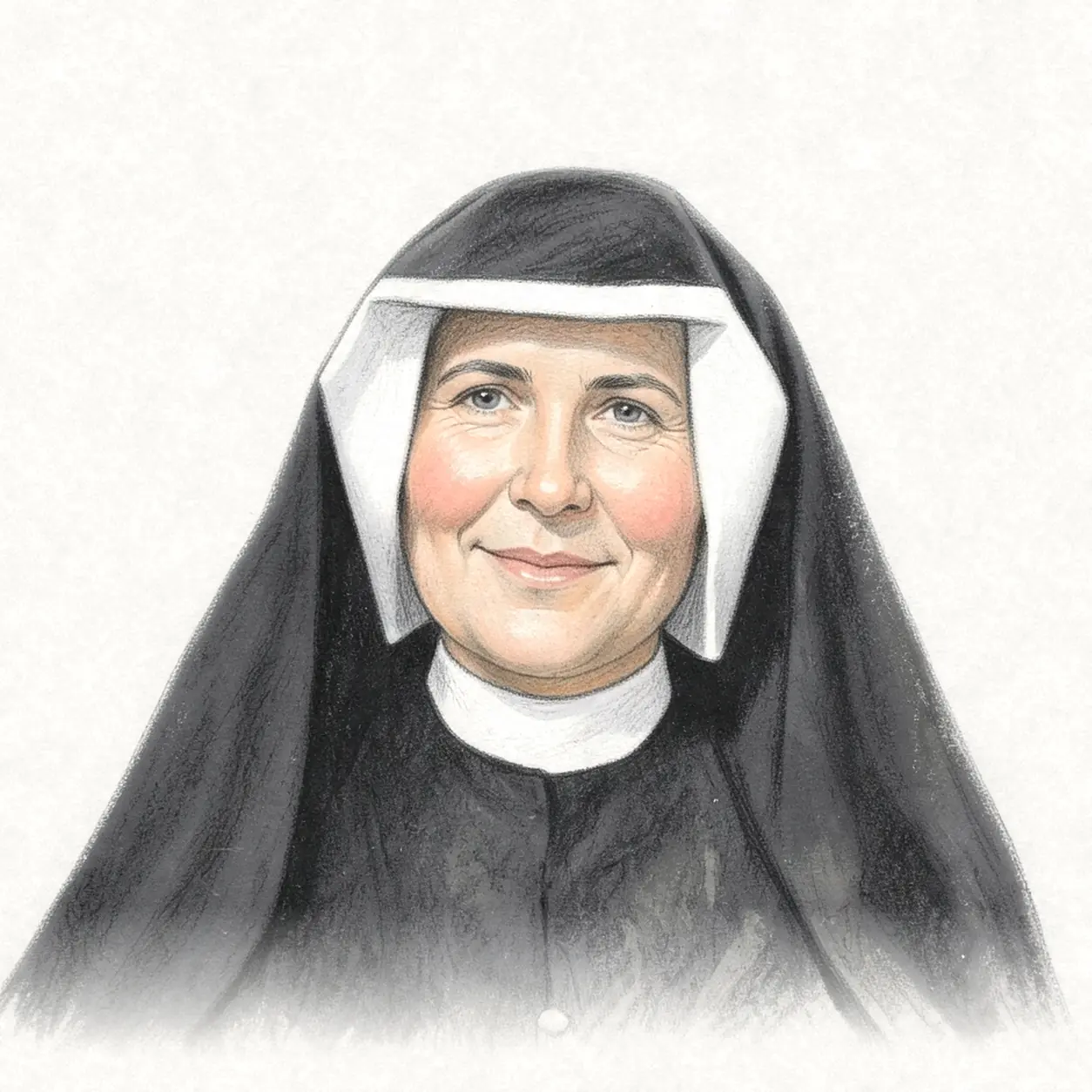
Saint Faustina Kowalska
Nun · 1905-1938
Virgin, religious, mystic, apostle of Divine Mercy
Saint Faustina Kowalska, whose birth name was Helena Kowalska, was born on August 25, 1905, in the village of Głogowiec, which at the time lay in the Russian partition of Poland. She was the third of the ten children of Marianna and Stanisław Kowalski, poor farmers. She was baptized in the nearby parish of Świnice Warckie. As a child she stood out for her piety, her diligence, and her sensitivity to the poverty of others. She attended school only briefly, and as a teenager she worked as a domestic servant to earn her keep and support her family.
Even as a young girl she felt called to religious life. After her parents’ initial opposition and a period of working for wages, in 1925 she entered the Congregation of the Sisters of Our Lady of Mercy in Warsaw. In the convent she received the name Maria Faustina. For thirteen years she served in various houses of the congregation, including those in Krakow, Płock, and Vilnius. She carried out ordinary duties: she worked as a cook, a gardener, and a portress.
Outwardly her religious life was simple and ordinary, and at the same time - as her biography describes - marked by deep prayer and mystical experiences. Divine Mercy became the central theme of her spirituality. In her Diary, Faustina recorded her spiritual experiences and prayers. Her mission came to be associated with reminding people of God’s mercy and with encouraging trust in God and the showing of mercy to one’s neighbor. The forms of devotion connected with her mission include the image of the Merciful Jesus with the inscription “Jesus, I trust in You,” the Chaplet of Divine Mercy, and the Feast of Divine Mercy.
Faustina suffered from tuberculosis, which seriously weakened her health in the last years of her life. She died in Krakow on October 5, 1938, at the age of 33.
Pope John Paul II beatified her on April 18, 1993, and canonized her on April 30, 2000. In the Church she is venerated as the apostle of Divine Mercy; her liturgical memorial falls on October 5. Her example reminds us that the message of mercy embraces both trust in God and concrete mercy toward others.