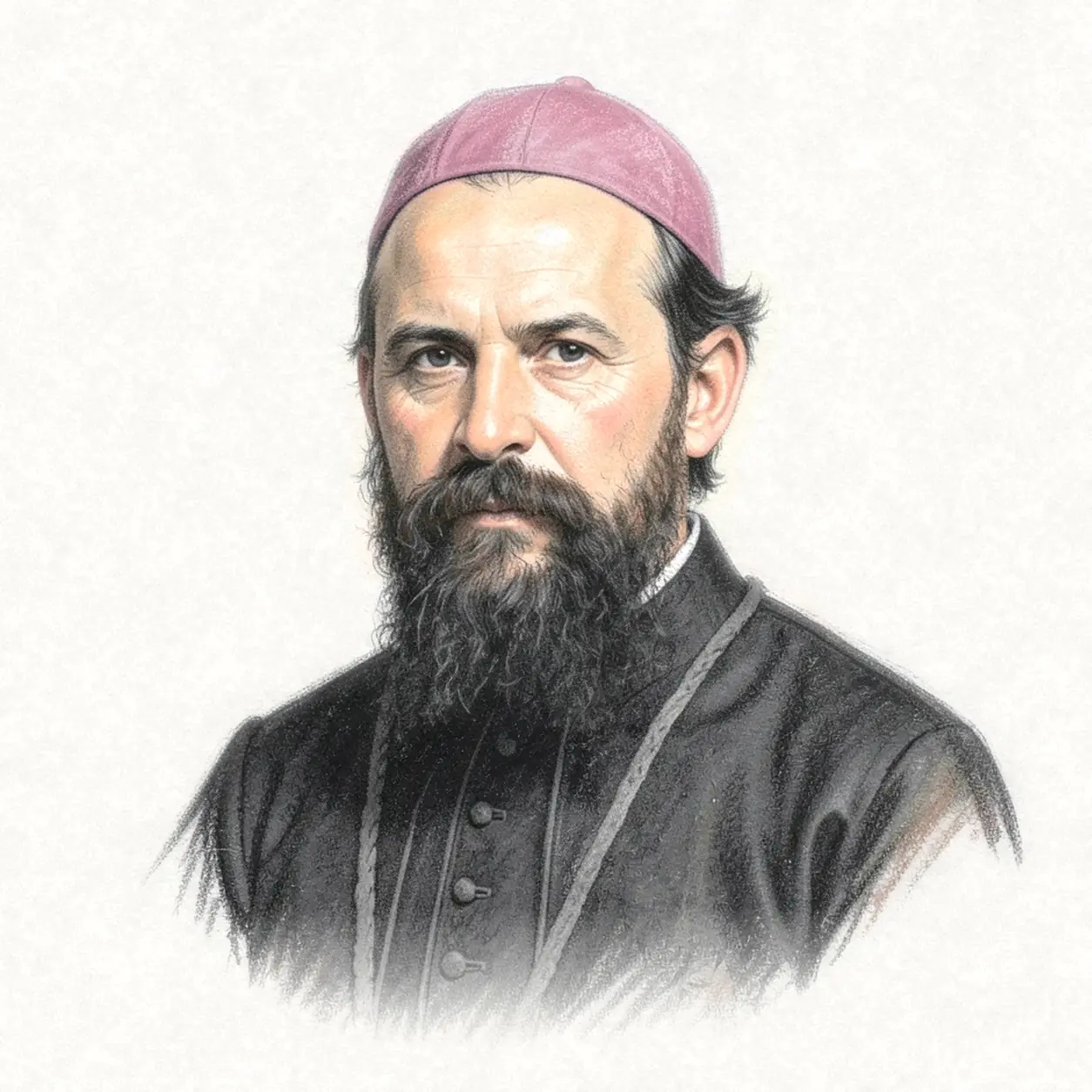
Saint Daniel Comboni
Bishop · 1831-1881
Bishop, missionary in Sudan, founder of the Comboni Missionaries and Sisters
Saint Daniel Comboni was an Italian missionary, the first Catholic bishop of Central Africa, and the founder of two missionary congregations. The Roman Martyrology commemorates him on October 10, the day of his death in Khartoum in Sudan, and says that he tirelessly spread the Gospel in Africa and provided in many ways for human dignity.
He was born on March 15, 1831, in Limone sul Garda, into a poor farming family, the son of Luigi and Domenica. He was the fourth of eight children and the only one to reach adulthood. He studied in Verona at the institute founded by Fr. Nicola Mazza, where he completed philosophy and theology and came to know Central Africa from the accounts of missionaries. In 1849 he resolved to devote his life to Africa. He was ordained a priest on December 31, 1854.
In 1857 he set out with five other missionaries of the Mazza institute and, after a four-month journey, reached Khartoum. Hard work, the climate, and disease took several of his young companions, and he himself had to return to Italy because of illness. Yet he did not abandon Africa. In 1864, while praying at the tomb of Saint Peter in Rome, he conceived a plan for the rebirth of Africa, summed up in the words “Save Africa with Africa”: Africans themselves were to become heralds of the Gospel among their own peoples. Pope Francis stressed that there was nothing of colonialism in this.
He traveled across Europe and asked kings, bishops, and ordinary people for prayer and support for the missions. He also launched the first missionary magazine in Italy. In Verona he founded an institute of missionaries in 1867 and an institute of missionary sisters in 1872; today they are the Comboni Missionaries of the Heart of Jesus and the Comboni Missionary Sisters. At the First Vatican Council, as theologian to the Bishop of Verona, he gathered the signatures of seventy bishops on a petition for the evangelization of Central Africa.
On July 2, 1877, he was appointed Vicar Apostolic of Central Africa, and a month later he was ordained a bishop. In 1877 and 1878 an unprecedented drought and famine cut the local population in half and nearly destroyed the work of the mission. Comboni fought for the abolition of the slave trade. In 1880 he set out for Africa for the eighth and last time.
Worn out by work, by the deaths of his collaborators, and by slander, he fell ill and died in Khartoum on the evening of October 10, 1881, at the age of fifty. His words have been preserved: “Io muoio, ma la mia opera non morirà” (“I am dying, but my work will not die”).
John Paul II beatified him on March 17, 1996, and canonized him on October 5, 2003, in Rome. In his canonization homily he called him an apostle of Christ among the Africans. From the mission founded by the Comboni Missionaries at Kitgum in Uganda came Blessed Daudi Okelo and Jildo Irwa, young catechists and martyrs.