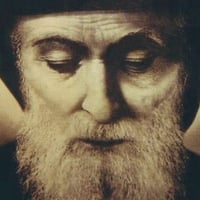
Saint Charbel Makhlouf
Priest · 1828-1898
Priest, Maronite monk, hermit
Saint Charbel (Youssef Makhlouf) was born on May 8, 1828, in Lebanon. After entering the Lebanese Maronite Order, he took the name Charbel. Ordained a priest, and desiring to live in strict solitude and to attain greater perfection, he withdrew from the monastery of Annaya to a hermitage, where he served God through an extremely austere life, constant fasting, and prayer.
He excelled in asceticism, in work, and in obedience. His day was filled with prayer, penance, and work. He was completely detached from material goods and from his own will. He renounced money. He usually fasted and slept little. He spoke only when asked, and he answered in a quiet voice. It was soon noticed that he had a vocation to a life of seclusion. He was gentle, serene, always courteous, and absorbed in prayer. He always wore his hood pulled down over his eyes. His cell was completely bare and measured only 6 square meters. A lamp and a jug were its only furnishings. His bed was a mattress of oak leaves covered with a goatskin. He often lay down on the bare ground. In a wicker basket he kept the Bible, The Imitation of Christ, the Life of Saint Anthony the Hermit and other writings of the Fathers of the Church, and the Confessions of Saint Augustine.
He died on Christmas Eve 1898. On December 25, Christmas Day, he was buried in a common grave adjoining the outer wall of the monastery, outside the enclosure. On the first night after the funeral, a mysterious light was seen above the burial place, visible throughout the valley and resembling electric light; it shone for 45 nights from the day of the funeral. It lit up the dome and the wall of the monastery more brightly than daylight. This caused a great stir. Thousands of Christians and Muslims came to the grave to see the phenomenon. Some even managed to open the grave and take a piece of clothing or a few hairs from the hermit’s beard. For safety reasons, the Maronite Patriarch ordered the body to be moved into the monastery. After that, the light stopped appearing.
Father Charbel’s grave was opened in the presence of a physician and other witnesses. It contained water and mud, but the saint’s body remained intact. Father Charbel’s body gave off a wonderful fragrance and a fluid of unknown origin (a kind of serum mixed with blood). It was washed, clothed in new garments, and placed in a coffin in a chamber closed to the faithful. Every two weeks the monks had to change his garments because of the fluid that kept seeping out. From that time on, many healings began to take place through Father Charbel’s intercession, among both Christians and Muslims.
Charbel was beatified by Pope Paul VI on December 5, 1965, in the closing days of the Second Vatican Council. He said on that occasion: “A hermit of the Lebanese mountains is numbered among the blessed. He is the first confessor from the East whom we place among the blessed according to the rules now in force in the Catholic Church. A symbol of the unity of East and West! A sign of the union that exists among Christians throughout the world! His example and his intercession are more necessary today than ever before. (...) It is precisely this blessed monk of Annaya who should serve as our model, showing us the absolute necessity of prayer, of the practice of hidden virtues, and of self-mortification. For the Church also makes use, for apostolic ends, of centers of contemplative life, from which praise and prayer rise to God with a fervor that never cools.” The same pope canonized Charbel on October 9, 1977.
Many pilgrimages are made to his tomb, and the healings obtained through his intercession are a clear sign of God’s action in the modern world. Relics of the saint are kept, among other places, in the Saint John Paul II Sanctuary in Łagiewniki.
No one photographed Father Charbel or painted his portrait during his lifetime. No one except his fellow monks had seen his face. On May 8, 1950, a few Maronite missionaries had a group photograph taken in front of Father Charbel’s hermitage. When the photograph was developed, it turned out to include an extra, mysterious figure: a hooded monk with a white beard.
Only the older monks recognized him as Father Charbel. This photograph became the model for all his portraits, including those hung in Saint Peter’s Square during the beatification and canonization.