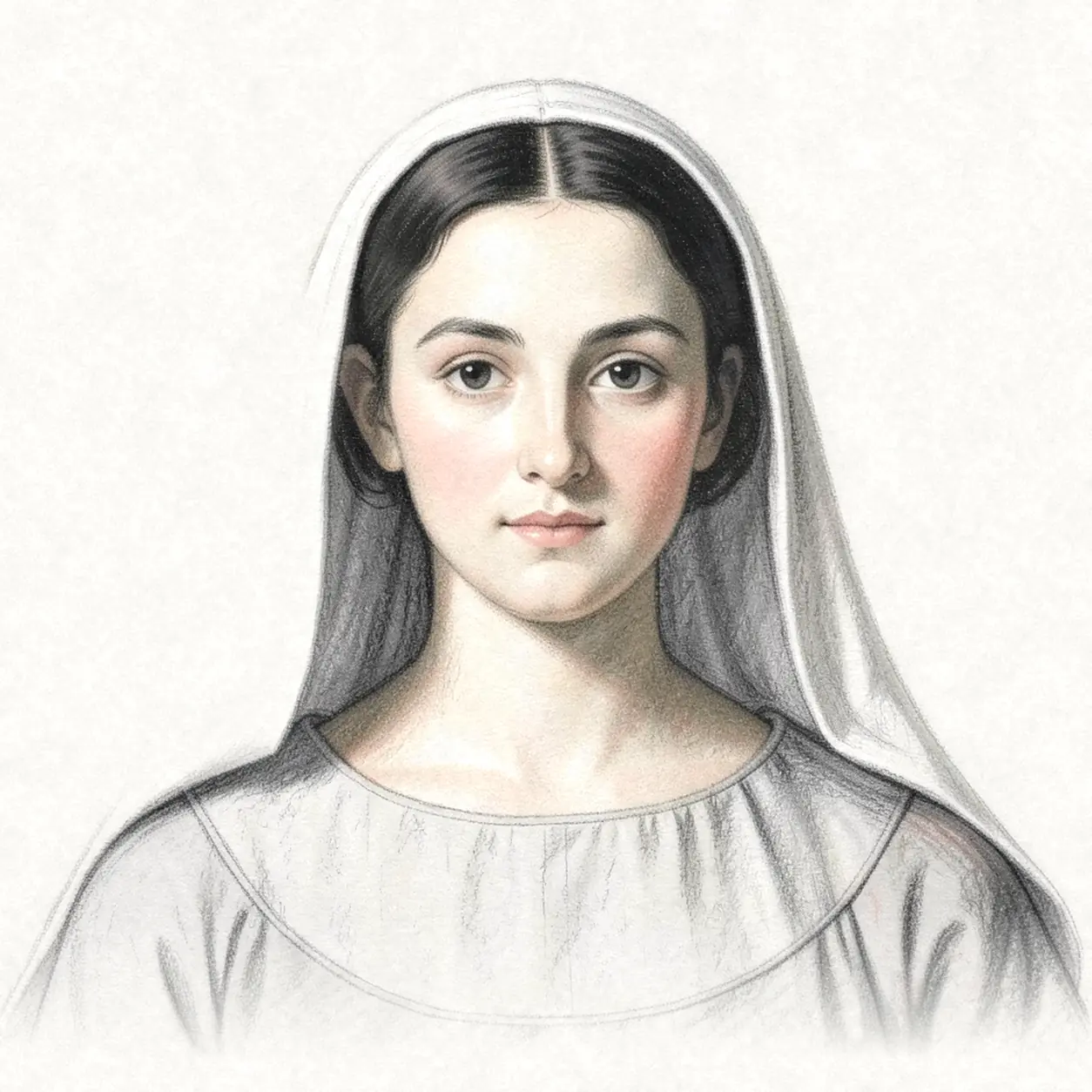
Saint Cecilia
Lay Person
Virgin and martyr, Roman woman, patroness of church music
Saint Cecilia was a Roman virgin and martyr of the first centuries of Christianity. She is among the most venerated saints of ancient Rome, her name is mentioned in the Roman Canon, and musicians honor her as their patroness. The Church commemorates her on November 22.
Little is known for certain about her life. We do not know the year of her birth or of her death. Tradition places her martyrdom around the year 230, under Emperor Alexander Severus and Pope Urban I, but there is no certainty. The Roman Martyrology speaks with caution: it reports that, as a virgin and martyr, she is said to have won the double palm for love of Christ in the cemetery of Callistus on the Appian Way, and it recalls that a titular church in Trastevere has borne her name since antiquity.
Her story comes down to us in the Passion of Saint Cecilia, a work of the fifth century that is more literary than historical. According to it, Cecilia, a girl of a distinguished Roman family, was given in marriage to Valerian. On their wedding day she confided to him that she was a Christian and had vowed her virginity to God. Valerian let himself be persuaded and was baptized by Pope Urban, and soon his brother Tiburtius came to believe as well. Both brothers were beheaded together with Maximus, an officer of the prefect who had himself been converted. The Martyrology commemorates these three martyrs on April 14.
As for Cecilia herself, the account goes on, the prefect ordered her to be shut in the overheated bath of her own house so that she would suffocate. When after a day and a night she was found alive, he sentenced her to be beheaded. The executioner struck three times but could not sever her head. Cecilia lived three more days: she gave her possessions to the poor and set aside her house to become a church. Her tomb was venerated in the Catacombs of Saint Callistus, in a crypt adjoining the crypt of the popes of the third century.
The church that bears her name in Trastevere has existed since antiquity and, according to tradition, stands on the site of her house. In 545 it was there, during the celebration of November 22, that Pope Vigilius was seized, so that her feast was already being kept on that day. In 821 Pope Paschal I restored the basilica and transferred the body of the martyr to it from the catacombs. In 1599, during another restoration of the church, her tomb was opened, and the sculptor Stefano Maderno portrayed her in marble as, according to the accounts, she was found. The statue lies to this day beneath the high altar.
A single sentence of the old account linked her with music: while the instruments played at her wedding, Cecilia sang in her heart to the Lord alone. Since the late Middle Ages she has been depicted with an organ and invoked as the patroness of musicians and singers. On the day of her memorial in 1903, Saint Pius X issued the motu proprio Tra le sollecitudini on church music. On the hundredth anniversary of that document, John Paul II called her the patroness of sacred music.
Cecilia has been venerated as a saint since antiquity, without a formal canonization. John Paul II, celebrating Holy Mass in her basilica in 1984, called her a saint who is wholly Roman and at the same time universal.