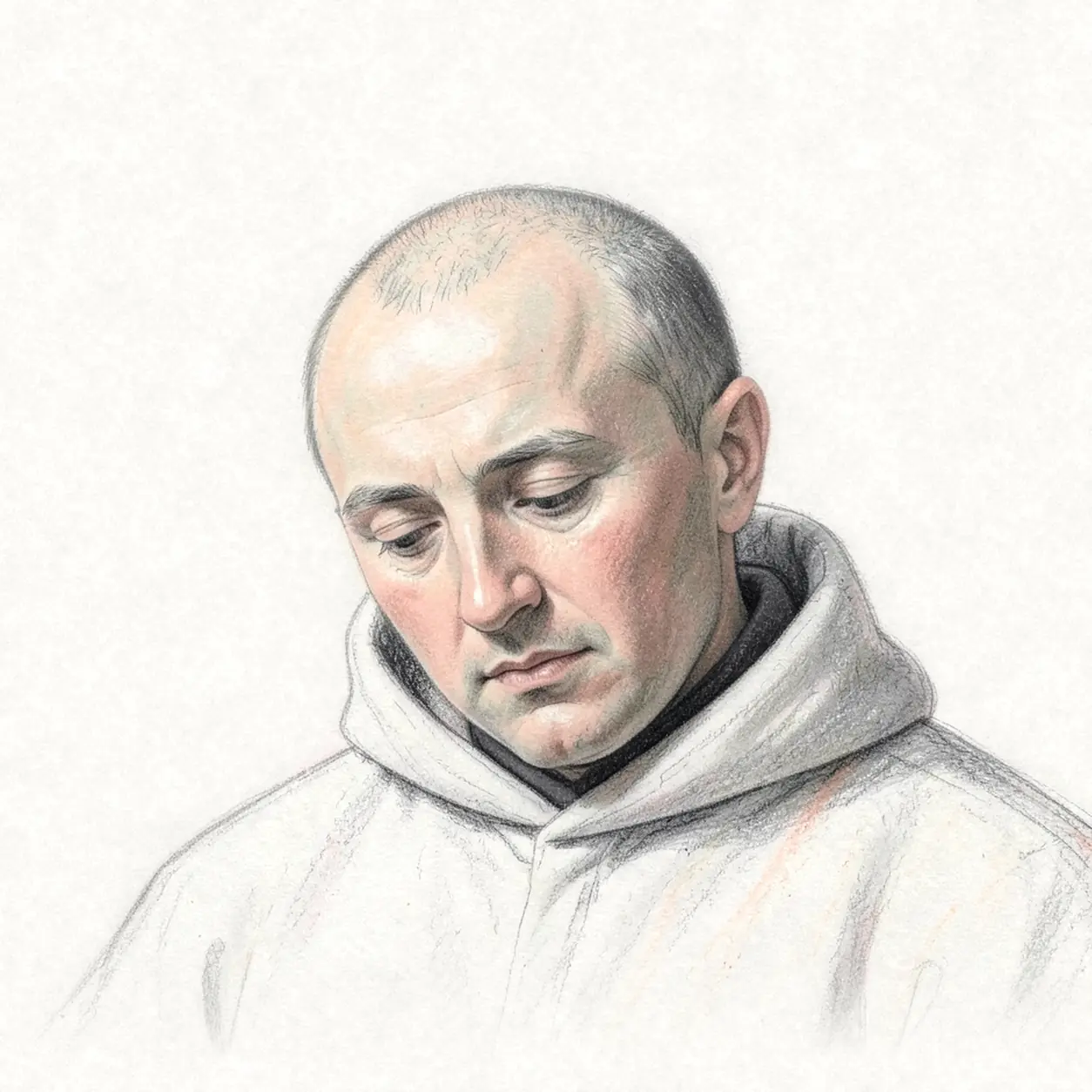
Saint Bruno the Carthusian
Priest · † 1101
Priest, founder of the Carthusians, master of the cathedral school of Reims
Saint Bruno was a priest and a respected teacher who gave up honors to seek God in solitude. With a few companions he gave rise to the Carthusian Order, in which the life of hermits is combined with elements of common life. His memorial falls on October 6.
He was born in Cologne around 1030; the exact date is not known. He was a canon of the church of Saint Cunibert in his native city and was educated at the cathedral school of Reims, one of the most highly regarded of its time. For some twenty years he directed that school and taught theology, and later he became chancellor of the Church of Reims. Among his pupils was Odo of Châtillon, the future Pope Urban II.
When Manasses, who was accused of bribery and of seizing the goods of the Church, became archbishop of Reims, Bruno and several other canons opposed him and suffered persecution for it. In 1080 Pope Gregory VII deposed Manasses. Many saw Bruno as his successor, but he decided to leave the world and live for God alone. For a time he sought his way with Saint Robert, abbot of Molesme.
In June 1084 Bruno and six companions came to the bishop of Grenoble, Saint Hugh, who led them into the remote valley of the Chartreuse in the Alps. The name of the Carthusians comes from this place. The monks lived in separate cells in silence and prayer and came together for part of the liturgy. Bruno led the community for six years.
In 1090 Pope Urban II, his former pupil, called him to Rome to help him with his counsel in the needs of the Church. Bruno obeyed, although it meant leaving his brothers. He did not accept the archbishopric of Reggio and settled in the wilderness of La Torre in Calabria, where Serra San Bruno stands today. Support came from Count Roger, the Norman ruler of Calabria and Sicily. Thus the hermitage of Santa Maria della Torre came into being.
From Calabria he wrote a letter to his friend Raoul, provost of the chapter of Reims, urging him to leave what passes away and to reach for what is eternal. Benedict XVI, visiting the charterhouse of Serra San Bruno on October 9, 2011, called these words the core of Carthusian spirituality. A letter of Bruno to his brothers at the Chartreuse has also survived. Before his death he made a profession of faith in the Holy Trinity before his brothers. He died on October 6, 1101. His brothers remembered him as a man whose face was always joyful and who joined a father’s strength with a mother’s tenderness.
Bruno never went through a canonization process. In 1514 Pope Leo X, at the request of the Carthusians, approved his cult and allowed the order to celebrate his feast, and in 1623 Gregory XV extended it to the whole Church. On the ninth centenary of his death, John Paul II pointed to Bruno as a man who was able to set aside his own plans in order to answer the pope’s request and serve the Church.