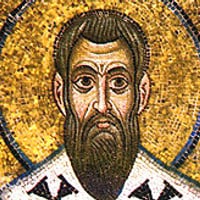
Saint Basil the Great
Bishop · † 379
Bishop of Caesarea in Cappadocia, Doctor of the Church, author of monastic rules
Saint Basil the Great was born in Caesarea in Cappadocia in 329. Both his parents and four of his ten siblings were numbered among the saints. What he lived through after the death of his brother profoundly changed his life. He decided to devote himself to religious life: he gave his property to the poor and founded a hermitage at Neocaesarea (present-day Niksar in Turkey). Soon Saint Gregory of Nazianzus joined him. Together they compiled a collection of the most valuable passages from the writings of Origen (the Philokalia). There, too, Basil began writing his Moralia and an outline of the Asceticon, the future Basilian Rule, which was of enormous importance for the development of communal religious life in the East. Basil’s ideal of monastic life was a fraternal community devoted to asceticism and meditation, serving the Church both through the study of the faith (exploring the mysteries of Revelation and defending it against heresies) and through pastoral and charitable work.
After founding several other monasteries, he was ordained a priest, and in 370 he became Archbishop of Caesarea, an office he held until his death in 379. As Archbishop of Caesarea he showed the gifts of a statesman and also distinguished himself as an excellent administrator and pastor, devoted to the good of his flock. He tirelessly defended it, by the spoken and the written word, against the contagion of the Arian heresy. He developed extensive charitable work in his diocese, building on the outskirts of Caesarea a complex of buildings for the poor and for travelers (the so-called Basiliad). He was a man of broad learning, an outstanding orator, and a hardworking and merciful shepherd.