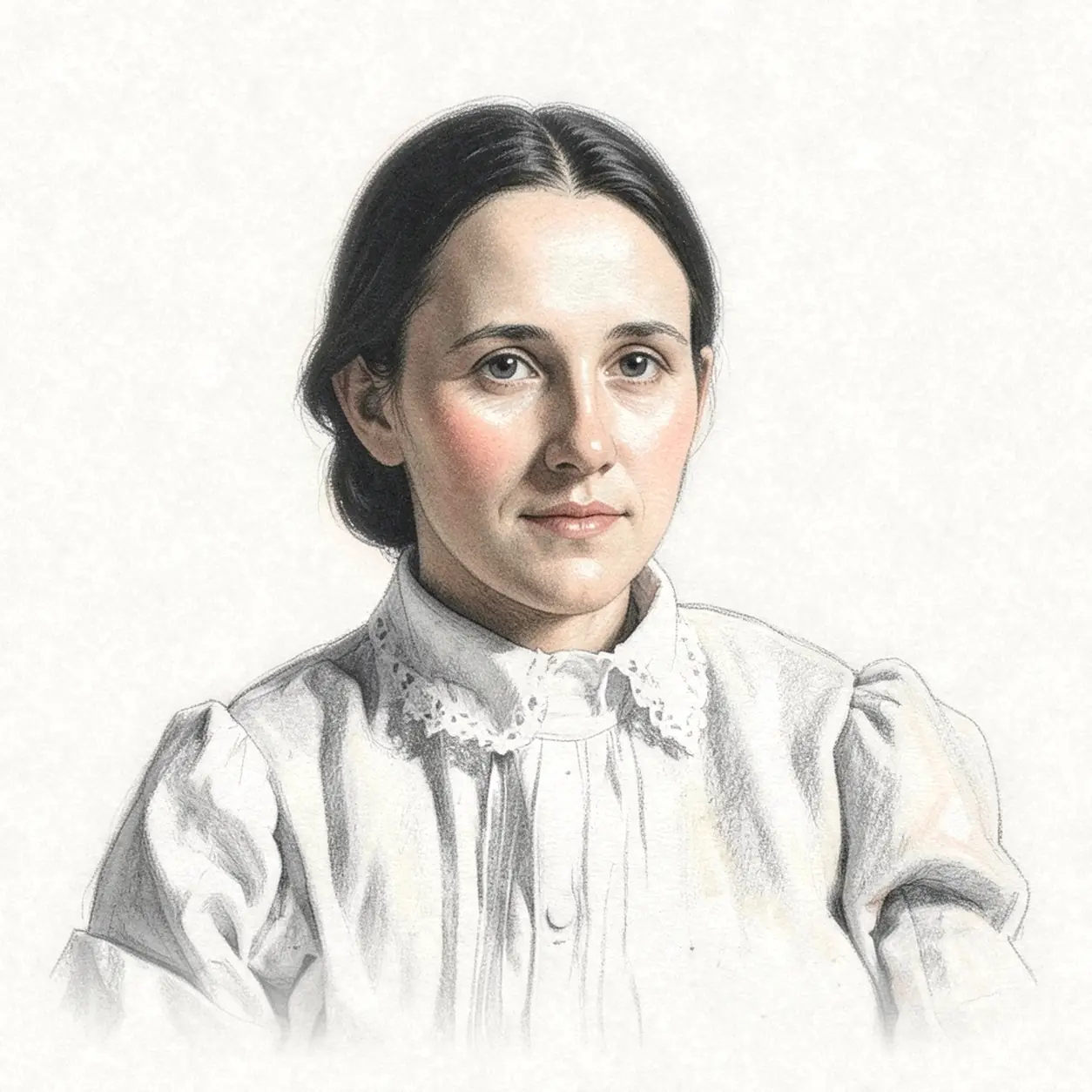
Saint Anna Schäffer
Lay Person · 1882-1925
Virgin, maidservant from Bavaria, lay Franciscan tertiary
Saint Anna Schäffer was a simple young woman from Bavaria who, after a serious accident at work, was confined to her bed for more than twenty years. She accepted her suffering as a vocation, and her sickroom became a place of prayer and of consolation for others. The Church commemorates her on October 5.
She was born on February 18, 1882, in Mindelstetten in the Diocese of Regensburg, into the poor family of a carpenter. She received her First Holy Communion on April 12, 1893, and on that day promised God that she would be a victim of expiation. She dreamed of entering a missionary congregation. When her father died in 1896, the family fell into destitution, and thirteen-year-old Anna went into service. She worked in Regensburg, Landshut, and other places to help her family and to earn the dowry needed to enter a convent.
The turning point came on February 4, 1901. Anna was then working at the forester’s house in Stammham. In the laundry she climbed onto the rim of a boiler of boiling lye to put a stovepipe back in place, slipped, and fell in. Both her legs were severely scalded, and gangrene set into the wounds. After three months in the hospital at Kösching she returned to Mindelstetten, where her mother cared for her. Many operations and treatments brought no improvement, and from 1902 Anna could no longer get out of bed.
The family had to sell their house and workshop. From then on Anna and her mother lived in a single small room, and the parish priest of Mindelstetten helped to support them and was her spiritual director. For years she endured pain, cramps, and contractions of her muscles. At first she rebelled against her fate. In time, as Benedict XVI said, she came to understand her situation as a loving call from the Crucified One to follow him: her bed became her convent cell, and her suffering a missionary service.
Anna spoke of three keys to heaven that God had given her. The largest, made of raw iron and heavy, was her suffering; the second was her needle, and the third her pen. She wrote letters to many people, and as long as her strength allowed she sewed and embroidered to give joy to others. Her favorite motif was the Heart of Jesus, whose flames she depicted as ears of wheat, a sign of the Eucharist. Her parish priest brought her Holy Communion every day. Many people came to her seeking advice, consolation, and prayer. In 1910 she was received into the Third Order of Saint Francis.
In 1925 she fell from her bed and suffered a head injury that weakened her sight and her speech. She died in Mindelstetten on October 5, 1925. Crowds came to her funeral. Her tomb is today in the parish church of Mindelstetten and is a place of pilgrimage.
John Paul II beatified her on March 7, 1999, in Saint Peter’s Basilica, and Benedict XVI canonized her on October 21, 2012, in Saint Peter’s Square. In his homily the pope asked that her intercession strengthen the Christian hospice movement.