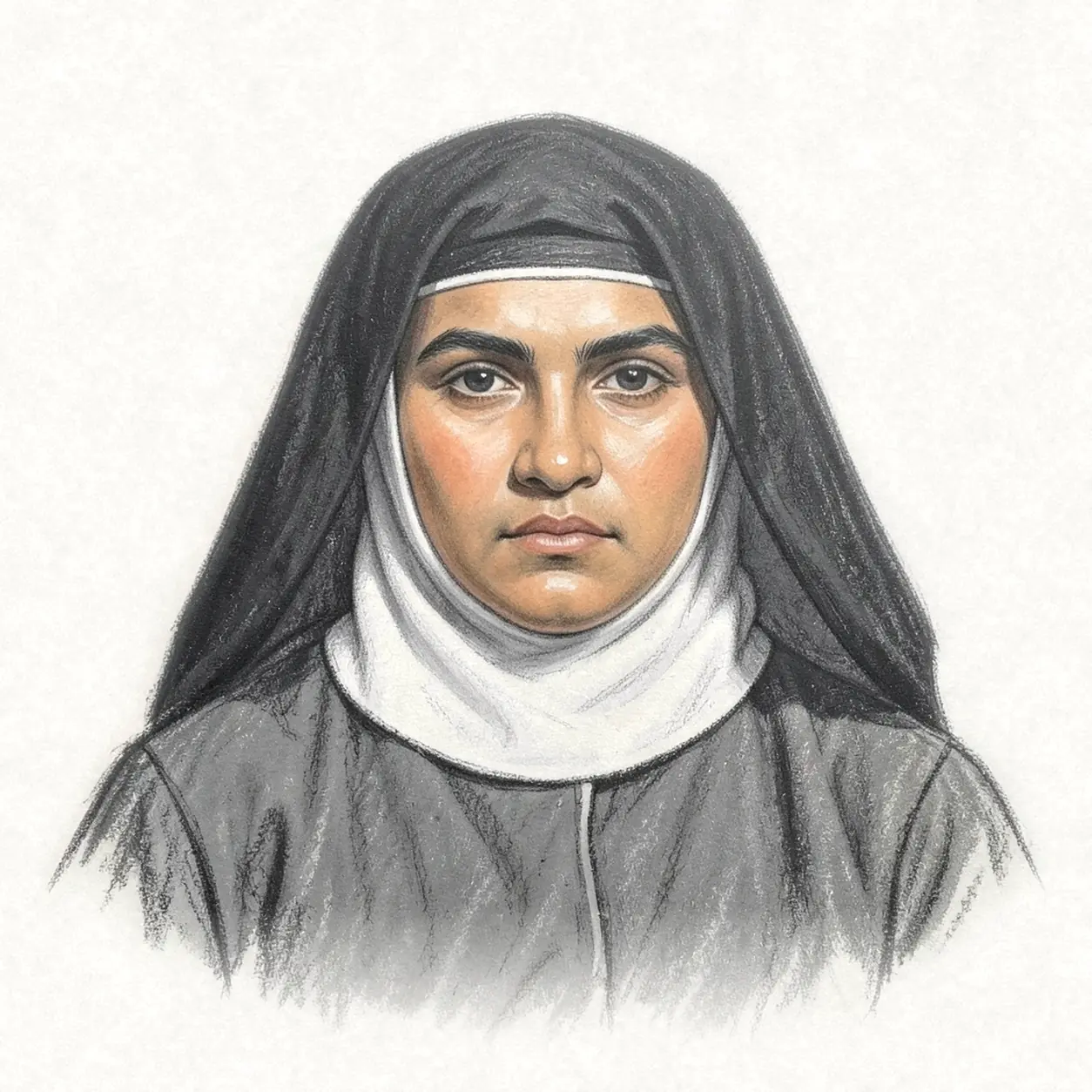
Saint Alphonsa of the Immaculate Conception
Nun · 1910-1946
Virgin, Franciscan Clarist, first woman from India to be canonized
Saint Alphonsa of the Immaculate Conception, born Anna Muttathupadathu, was a religious sister of the Franciscan Clarist Congregation in the Indian state of Kerala and belonged to the Syro-Malabar Church. Almost her entire short religious life was filled with grave illness, which she bore patiently and with joy. The Church commemorates her on July 28, the day of her death.
She was born on August 19, 1910, in Kudamaloor, in the Diocese of Changanacherry, into an old Syro-Malabar family. At baptism she received the name Annakutty, a diminutive of Anna. Her mother died when the little girl was three months old. She spent her first years with her grandparents; her grandmother taught her to pray and to love the poor. At school she also made friends with Hindu children. From 1920 she was brought up by an aunt, a stern woman who wanted to arrange an advantageous marriage for her and did not favor her vocation.
From childhood Anna longed to belong to Jesus alone. When she was thirteen, a marriage was arranged for her. After a night spent in prayer she put her foot into burning embers, hoping that once disfigured she would no longer attract anyone. Her confessor directed her toward Franciscan spirituality. In 1927 she became a boarding pupil at the school run by the Franciscan Clarist sisters in Bharananganam, and on August 2, 1928, she entered their congregation. She took the name Alphonsa of the Immaculate Conception, in honor of Saint Alphonsus Liguori.
Her religious formation was interrupted again and again by illness. When her strength allowed, she taught children at school, helped as a catechist in the parish, and, because of her beautiful handwriting, wrote official letters. For a time she was so gravely ill that her life was feared for. Then, during a novena to the Servant of God Kuriakose Elias Chavara, a Carmelite from Kerala, she suddenly recovered. She made her perpetual vows on August 12, 1936, which was then the feast of Saint Clare.
After her profession further illnesses followed: typhoid fever, double pneumonia, and in 1940 a severe nervous shock after she saw a thief at night. For about a year afterward she was unable to read or write. In 1945 a tumor, together with diseases of the stomach and liver, turned the last year of her life into unceasing suffering. The sisters remembered her as cheerful and kind. She wrote that the Lord had destined her to be an offering of suffering, and she confessed: “I consider a day without suffering as a day lost.” She died in the convent in Bharananganam on July 28, 1946, not yet thirty-six years old. Her tomb has become a destination for many pilgrims.
John Paul II beatified her on February 8, 1986, in Kottayam, together with Kuriakose Elias Chavara. Benedict XVI canonized her on October 12, 2008, in Saint Peter’s Square in Rome. In his homily he presented her as India’s first canonized saint, convinced that her cross was the way to the heavenly banquet the Father had prepared for her.