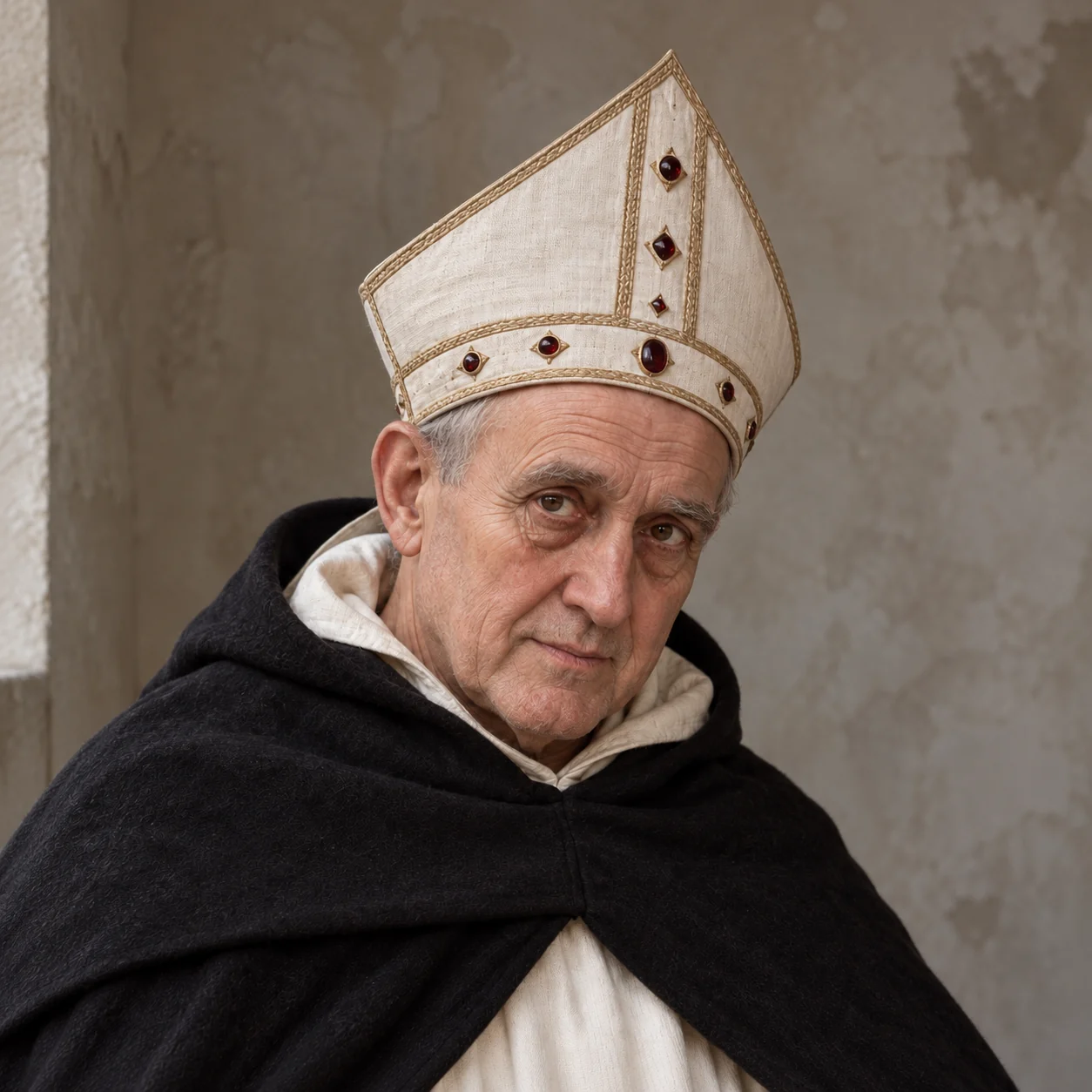
Saint Albert the Great
Bishop · † 1280
Bishop and Doctor of the Church, Dominican, patron of natural scientists
Saint Albert the Great was a Dominican, bishop of Regensburg, and Doctor of the Church, one of the great masters of medieval theology. He was the teacher of Saint Thomas Aquinas, and in his writings he joined theology and philosophy with the study of nature. The Church commemorates him on November 15.
He was born at Lauingen in Swabia, into a knightly family. The year of his birth is unknown: documents of the Holy See speak of the end of the twelfth century or the beginning of the thirteenth. As a young man he went to study in Padua, where he learned the liberal arts and the natural sciences. There he came to know the Dominicans and heard the sermons of Blessed Jordan of Saxony, the successor of Saint Dominic. Despite his family’s opposition he entered the Order of Preachers and received the habit from Jordan’s hands.
After his ordination to the priesthood he taught theology in several Dominican convents. Then he lectured at the University of Paris, where he became a master of theology. In 1248 he was entrusted with opening the order’s general house of studies in Cologne. He took with him from Paris his student Thomas Aquinas, whose gifts he was the first to recognize. After Thomas’s death he defended his teaching against objections.
Albert left a very large number of writings. He commented on Sacred Scripture and on the works of Aristotle, which Latin Europe was just then coming to know, convinced that what is truly rational agrees with the faith. He also described plants, animals, minerals, and the phenomena of the heavens, relying on observation. He was called the wonder and miracle of his age and the Universal Doctor.
In 1254 he became provincial of the Dominicans in the German province, which stretched from Flanders to Poland and Hungary. Before Pope Alexander IV at Anagni he defended the mendicant orders. The same pope appointed him bishop of Regensburg, a diocese burdened with debt and fallen into disorder. Albert accepted the office reluctantly. From 1260 to 1262 he restored peace in the diocese, then obtained from Urban IV permission to resign and returned to the poverty of his order. Later, at that pope’s request, he preached in Germany and Bohemia.
He spent the rest of his life mainly in Cologne. He taught, wrote, and reconciled those at odds, among them the archbishop of Cologne and the townspeople. In 1274, despite his advanced age, he took part in the Second Council of Lyon, which sought unity with the Greek Church. He died on November 15, 1280, in his cell in the convent of the Holy Cross in Cologne. His relics rest in the crypt of the Church of Saint Andrew in Cologne.
The Dominicans venerated him soon after his death. In 1484 Innocent VIII allowed the friars of Cologne and Regensburg to celebrate his feast, and in 1622 Gregory XV extended this permission to the cathedral of Regensburg; this date is given as the year of his beatification. On December 16, 1931, Pius XI extended his veneration to the whole Church and gave him the title of Doctor of the Church, which was equivalent to canonization. Ten years later Pius XII declared him the patron of natural scientists.