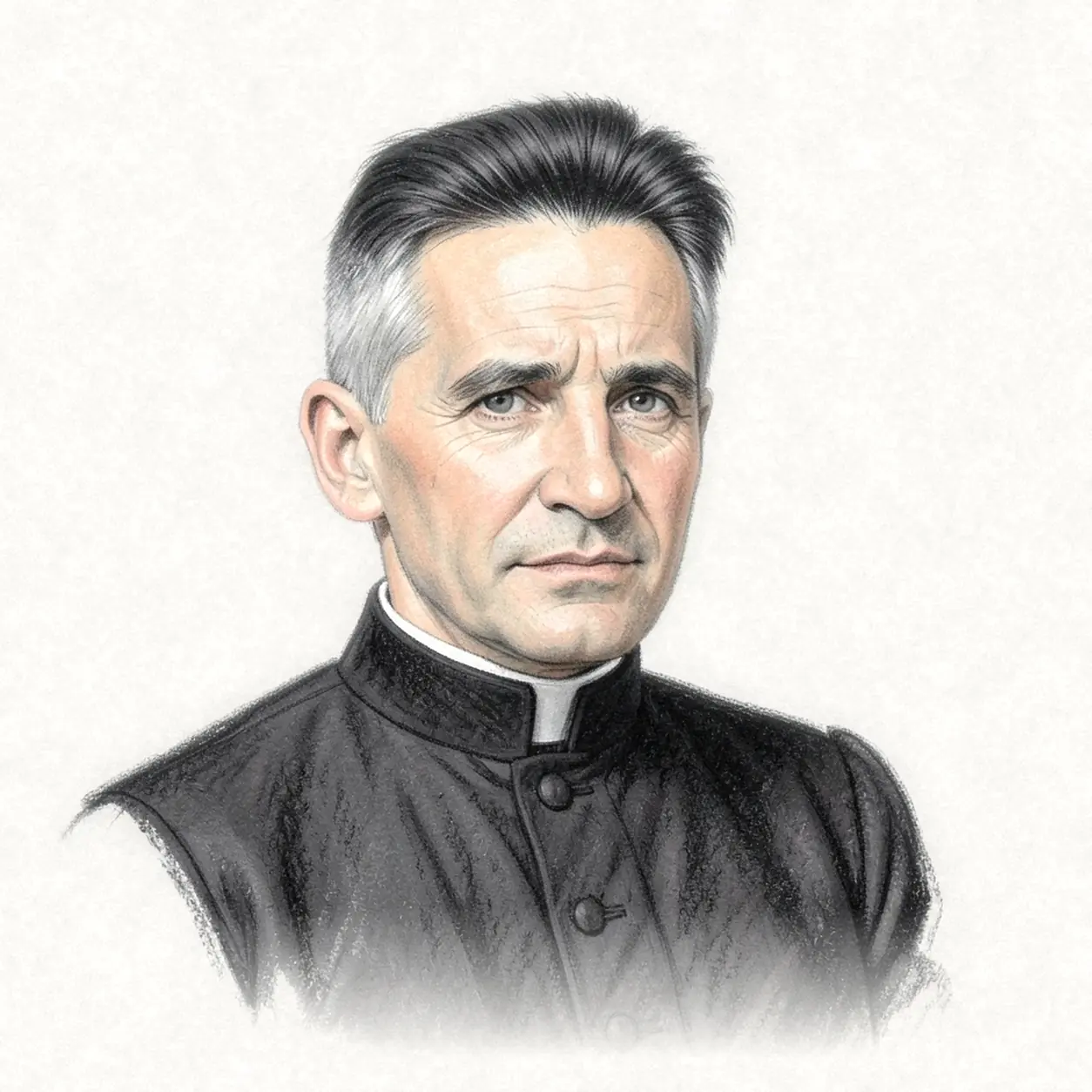
Blessed Rupert Mayer
Priest · 1876-1945
Priest, Jesuit, apostle of Munich, prisoner of Sachsenhausen
Blessed Rupert Mayer was a German Jesuit, a preacher and a helper of the poor, known as the apostle of Munich. For his open opposition to National Socialism he was imprisoned, sent to a concentration camp, and cut off from the faithful. The Roman Martyrology commemorates him on November 1, the day of his death.
He was born on January 23, 1876, in Stuttgart, into the large family of a merchant. After finishing secondary school he wanted to join the Jesuits, but at his father’s wish he first became a priest of his home diocese of Rottenburg. He was ordained a priest on May 2, 1899. On October 1, 1900, he began his novitiate at Feldkirch in Austria, because the Jesuits were then banned in the German Reich.
For several years he preached parish missions in various parts of Germany. In 1912 the Archbishop of Munich entrusted him with the pastoral care of the newcomers who were streaming into the Bavarian capital from all sides. At that time Father Mayer helped found the congregation of the Sisters of the Holy Family. During the First World War he was a military chaplain. On December 30, 1916, he was severely wounded in Romania and lost his left leg.
In 1921 he became head of the Men’s Marian Congregation in Munich. He preached as many as seventy times a month and spent hours hearing confessions. In 1925 he introduced Sunday Masses for travelers at the main railway station. The poor called him their fifteenth Holy Helper, an allusion to the Fourteen Holy Helpers venerated in Bavaria.
From the beginning he said openly, also at public meetings, that the views of the National Socialists could not be reconciled with Christianity. He did not fall silent after 1933, although the police listened to his sermons. In 1937 he was forbidden to speak in public and was arrested. A special court gave him a suspended sentence of six months in prison. When he stepped into the pulpit again, he served the sentence at Landsberg from January to May 1938. On a prison questionnaire he wrote that he did not regard his lot as a disgrace but as the crowning of his life.
On November 3, 1939, he was arrested for the third time and taken without trial to the Sachsenhausen concentration camp. When his health declined, the authorities did not want him to die in the camp as a martyr. In August 1940 he was moved to the Benedictine abbey of Ettal, where he lived in isolation until the end of the war, with almost no contact with the faithful. This enforced silence was the heaviest sacrifice for him.
On May 11, 1945, he returned to Munich, which lay in ruins after the air raids. On the Solemnity of All Saints, November 1, 1945, he suffered a stroke while preaching during Holy Mass. He broke off, repeating the word “Lord,” and died soon afterward. He was buried in the Jesuit cemetery at Pullach, and in 1948 his remains were moved to the crypt of the Bürgersaal church in Munich. John Paul II beatified him on May 3, 1987, at the Olympic Stadium there. In Munich and in the Society of Jesus his memorial is kept on November 3.