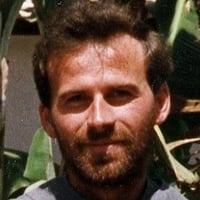
Blessed Michał Tomaszek
Martyr · 1960-1991
Priest and martyr, Conventual Franciscan, missionary in Peru
He was born on September 23, 1960, in Łękawica near Żywiec. He came from a God-fearing family. After finishing elementary school in Łękawica, he continued his education at the Franciscan Minor Seminary in Legnica (a general secondary school). His classmates recall that even then he stood out as a man of prayer. He spent much time in the friary chapel. Moreover, every night, after the lights in the dormitory were turned off, he knelt before a statue of Mary Immaculate that he had brought from his family home.
After his high school final exams, in 1980, he entered the Order. In his application for admission he wrote, among other things: “I have long been convinced that I have a vocation to the priesthood and to the Order, which I had the opportunity to consider more thoroughly at the Minor Seminary in Legnica. My desire is to work in the missions, so as to serve God and the Immaculata in this way.” He received the religious habit on the solemnity of Saint Francis, October 4, 1980. A year later, on September 1, 1981, he made his first vows. On the solemnity of Mary Immaculate, patroness of the Franciscan Order, December 8, 1985, in Krakow, he solemnly vowed to live forever in obedience, without anything of his own, and in chastity.
His confreres remember his religious zeal. He readily joined in occasional tasks and was actively involved in catechizing children with special needs and in preparing pastoral aids. He threw himself into pastoral work with all his youthful zeal and enthusiasm. As a good and conscientious priest, he won the trust of the faithful.
While serving in pastoral ministry in Pieńsk, he learned that two of his older confreres, Father Zbigniew Strzałkowski and Father Jarosław Wysoczański, were soon to leave for the missions in Peru. In July 1989 he joined them.
Having quickly mastered the basics of Spanish, Father Michał took up pastoral work in Pariacoto. In a short time he gathered a great many young people around the parish, who came for catechesis and prayer together, but also for recreation. He reached them through music and song.
Besides their pastoral work, the missionaries engaged in charitable activity: they took part in the national and diocesan food programs of Caritas and supported schools and libraries. By drawing the attention of international organizations, they helped create a program of disease prevention and health care to stop a cholera epidemic. They obtained medicines for the local people and drove the infected to the city hospital themselves. They focused on education and social welfare and helped supply the surrounding villages with water and basic sanitation.
At the time of Father Michał Tomaszek’s ministry, Peru was not a safe country. Since 1980 the Communist Party of Peru “Sendero Luminoso” (Shining Path) had been terrorizing the country, seeking to seize power through revolution. After eleven years of fighting, the Senderistas were looking for a target whose attack could bring them publicity and make it easier for them to seize power. Their choice fell on the Church, or more precisely on the diocese where the Franciscans worked. A few weeks before the missionaries’ martyrdom, the bishop informed the priests at a diocesan meeting that the terrorists had demanded that all foreign priests leave the country. Yet none of them left; all remained with their people.
On August 9, 1991, terrorists of the Communist Party of Peru “Shining Path” abducted the missionaries from the friary and murdered them, claiming that they “humiliated the people by distributing food that came from the imperialists, that religion is the opium of the people, and that by preaching peace and carrying out evangelizing and charitable work they were lulling the people to sleep so that the masses would not rise up in revolution.”
The day after the beatification, December 6, 2015, the chapel of the martyrs’ tomb was opened in Pariacoto. The painting above the tomb shows images of the missionaries inspired by local devotion. Father Michał is depicted with children, because in his pastoral work he devoted much time and heart to them. Now the faithful turn to him in matters of raising children and for help for whole families.