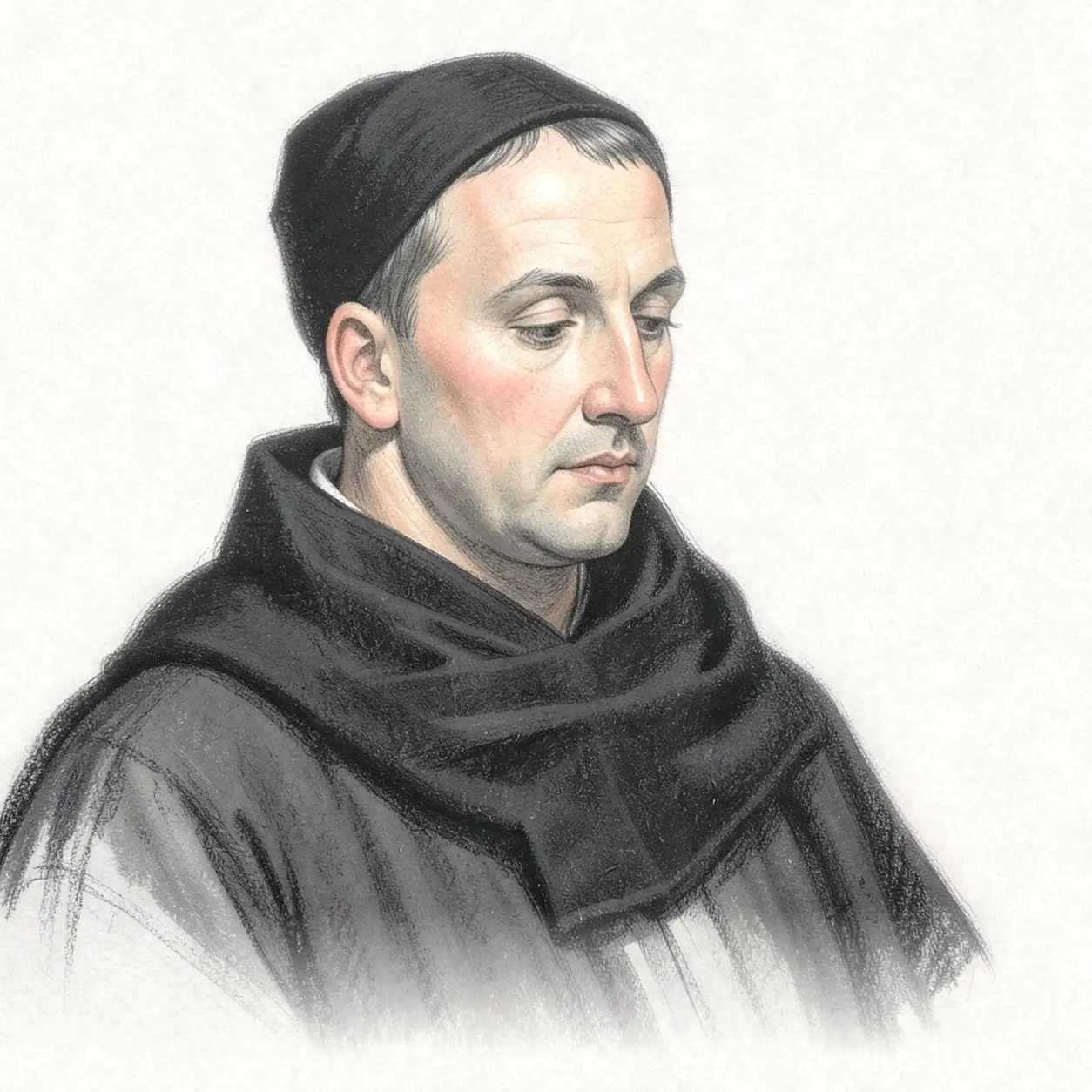
Blessed Fra Angelico
Priest · † 1455
Priest, Dominican, painter, patron of artists
Blessed Fra Angelico, known in the liturgy as John of Fiesole, was a Dominican, a priest, and a great painter of fifteenth-century Italy. The Roman Martyrology says of him that he always held fast to Christ and expressed in his paintings what he contemplated within, so as to lift people’s minds to heavenly things. The Church commemorates him on February 18.
He was born at the end of the fourteenth century at Vicchio in the Mugello, a district of Tuscany, and at baptism received the name Guido. The exact year of his birth is not known. From his youth he drew and painted miniatures. Together with his brother Benedetto he entered the Observant Dominicans, friars of a stricter discipline, at the convent of San Domenico in Fiesole, near Florence. The year of his entry is not certain either: John Paul II gave the year 1420. In the order he took the name John, made his profession, and became a priest.
At Fiesole he served as vicar and as prior of the convent. Among his early works are the “Annunciation” of Cortona and the “Coronation of the Virgin” from Fiesole. Giorgio Vasari, who wrote his life nearly a hundred years later, recorded that Brother John never began to paint without prayer and used to say that whoever does the works of Christ should always stay close to Christ.
From 1438 to 1445 he lived at the convent of San Marco in Florence, where the prior was Saint Antoninus, later archbishop of that city. He served there as bursar, and at the same time he decorated with paintings the friars’ cells, the chapter room, the corridors, and the cloister, and painted the altarpiece for the church. These frescoes are like a catechesis in images and lead the viewer to meditate on the passion and death of Christ.
In 1445 Pope Eugene IV called him to Rome and commissioned paintings from him in Saint Peter’s Basilica and in the Vatican Palace. As John Paul II recalled, in 1446 the pope wished to entrust the archbishopric of Florence to him. Brother John humbly declined and advised that this office be given to Antoninus. The next pope, Nicholas V, charged him in 1447 with decorating his private chapel with frescoes from the lives of Saint Stephen and Saint Lawrence.
In 1454 he returned to Rome. He died on February 18, 1455, in the convent attached to the church of Santa Maria sopra Minerva, and there he was buried. The inscription on his tomb calls him a true servant of God. He owes the name “Angelico,” that is, “the Angelic,” to the uprightness of his life and the beauty of his paintings, and for centuries the faithful called him blessed.
In 1955, on the five hundredth anniversary of his death, Pius XII called him a holy religious and a great artist. By the apostolic letter “Qui res Christi gerit” of October 3, 1982, John Paul II permitted his liturgical cult with the title of Blessed, which is equivalent to beatification. On February 18, 1984, during Mass in the basilica where his tomb lies, he proclaimed him patron of artists, especially of painters. He said then that in him faith became culture and art became prayer.