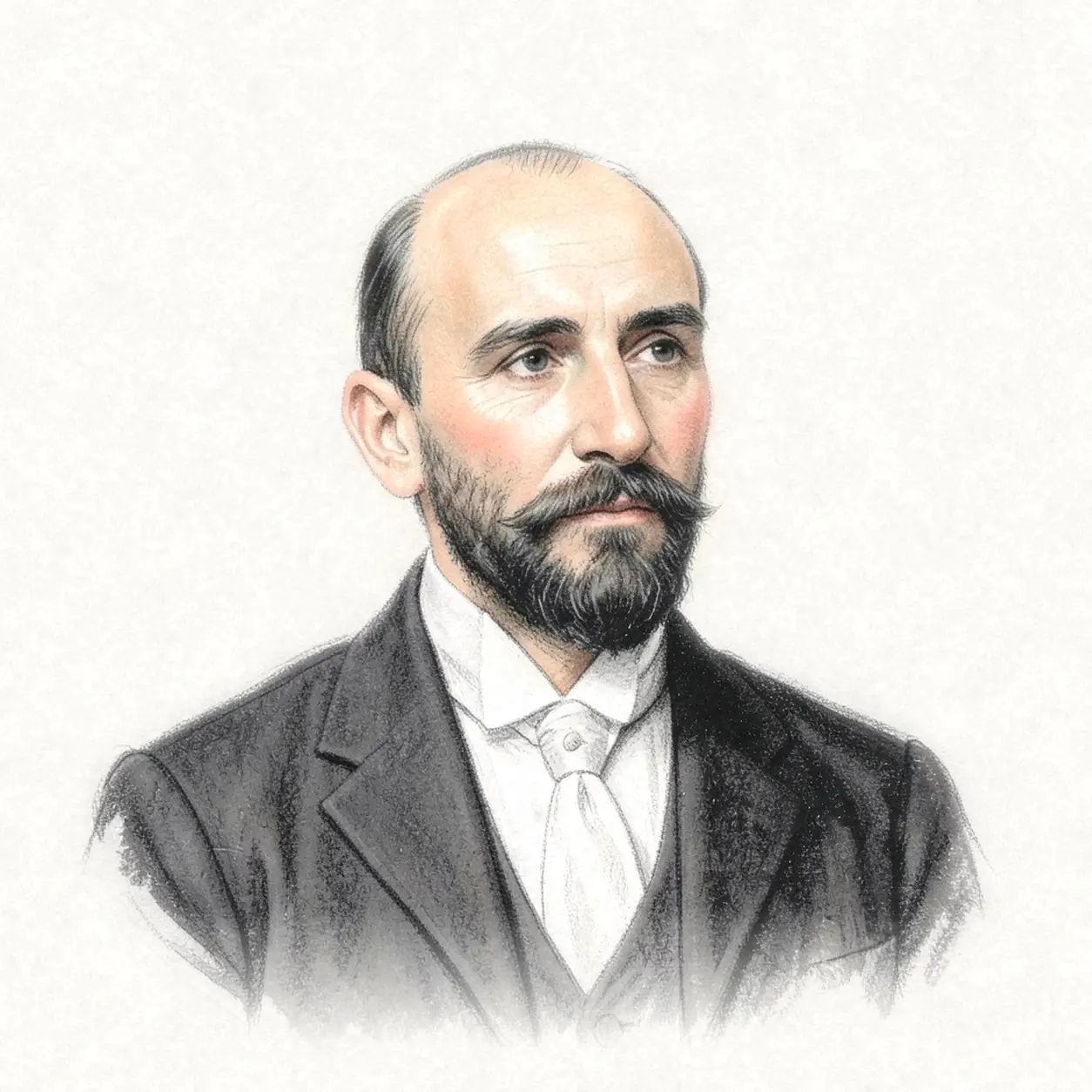
Blessed Contardo Ferrini
Lay Person · 1859-1902
Layman, professor of Roman law, Franciscan tertiary
Blessed Contardo Ferrini was an Italian scholar, a professor of Roman law, and a Franciscan tertiary. As a layman he walked toward holiness through scholarly work, teaching, and prayer. He was born on April 4, 1859, in Milan and died in 1902 in Suna on Lake Maggiore. The Roman Martyrology commemorates him on October 17.
He was the son of Rinaldo Ferrini, a professor at the Polytechnic of Milan, and Luigia Buccellati. His parents raised him in the faith. At the age of twelve he received his First Holy Communion, and from then on prayer and study filled his days. In 1876 he began to study law at the University of Pavia as a student of the Borromeo College. He did not hide his faith, and his classmates called him “Saint Aloysius.”
He completed his studies in 1880 with highest honors, presenting a dissertation on what the poems of Homer and Hesiod contribute to the history of criminal law. That same year he left on a scholarship for Berlin, where for about two years he deepened his knowledge of Roman law under the guidance of eminent scholars. Every morning he attended Holy Mass at Saint Hedwig’s Church, and as a member of the Conference of Saint Vincent de Paul he took part in works of mercy. Bound by a vow of chastity, he remained unmarried to the end of his life.
After returning to Italy, at the age of twenty-four, he began to teach Roman law in Pavia. In 1887 he took up a chair in Messina, in 1890 he moved to Modena, and in 1894 he returned to Pavia, where he taught until his death. In less than twenty years he published more than two hundred scholarly works, among them a study of Roman criminal law and critical editions of the sources of Roman-Byzantine law. He was esteemed by scholars in Italy and in Germany, including those who did not share his faith.
He drew his strength from daily Holy Communion, prayer, and meditation on Sacred Scripture. In 1886 he joined the Third Order of Saint Francis. In 1895 he was elected to the city council of Milan, where for four years he defended, among other things, the teaching of religion in elementary schools. He rested in the Alps, and the sight of the mountains led him to prayer. He was a friend of Father Achille Ratti, the future Pope Pius XI.
At the end of the summer of 1902, while on vacation in Suna, he fell gravely ill with typhoid fever. He died there on October 17, at the age of forty-three. People began at once to speak of him as a saint. His cause for beatification was taken up by the Catholic University of the Sacred Heart in Milan, which sees in him its forerunner. In 1942 his body was moved there.
Pope Pius XI promulgated the decree on his heroic virtues on February 8, 1931. Pius XII beatified him on April 13, 1947, in the Vatican Basilica. A few months later the same pope called him the model of the Catholic man of our day.