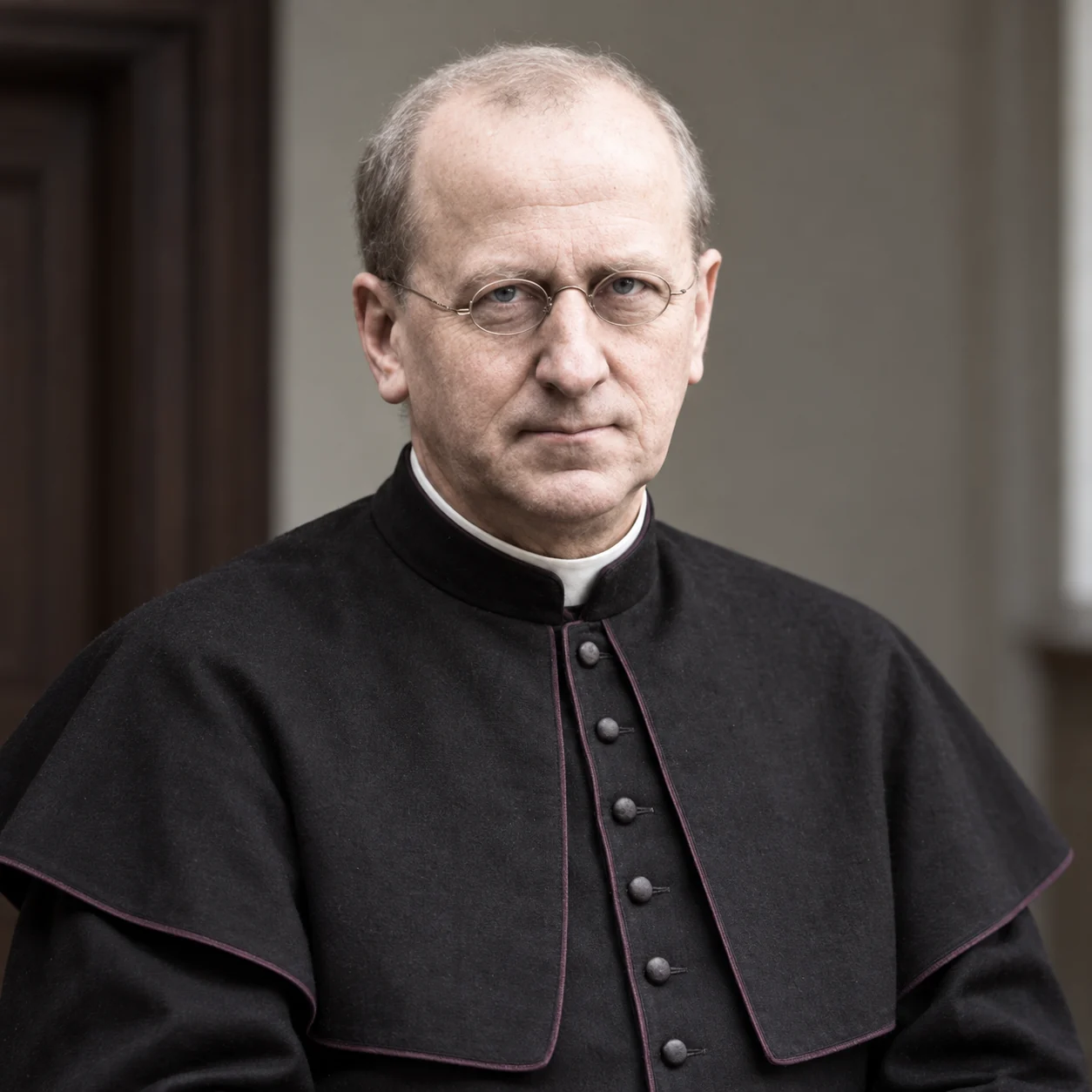
Blessed Bernhard Lichtenberg
Priest · 1875-1943
Priest and martyr, provost of Berlin cathedral, defender of the Jews
Blessed Bernhard Lichtenberg was a German priest, pastor of Saint Hedwig’s Cathedral in Berlin and provost of its chapter. In the years of National Socialism he prayed publicly for the persecuted Jews. Imprisoned for this, he died on the way to the Dachau concentration camp. The Church commemorates him on November 5.
He was born on December 3, 1875, in Ohlau in Silesia, today Oława in Poland, the second of the five children of the merchant August Lichtenberg. After finishing secondary school he studied theology in Innsbruck and in Breslau, today Wrocław, and on June 21, 1899, he was ordained a priest in the cathedral of Breslau.
A year later he was sent to Berlin, where he remained for the rest of his life. He worked in several parishes of the growing capital, and in 1913 he took charge of the parish of the Sacred Heart of Jesus in Charlottenburg. After the diocese of Berlin was established, he became a canon of the cathedral chapter, in 1932 pastor of Saint Hedwig’s Cathedral, and in 1938 provost of the chapter.
He opposed National Socialist ideology from the beginning. In 1935, on learning of the abuse of prisoners in the Esterwegen concentration camp, he lodged a complaint at the office of Hermann Göring. From 1938 he directed the relief office set up at the diocesan curia for Catholics of Jewish descent. In August 1941, in a letter to the Reich Physician Leader, he protested against the killing of the mentally ill and the disabled.
After the pogrom against the Jews in November 1938 he said in the cathedral: “Outside, the temple is burning. That too is a house of God.” From then on he prayed publicly every evening for the Jews and for Christians of Jewish descent, and in time also for the prisoners in the concentration camps. Denounced by two women, he was arrested by the Gestapo on October 23, 1941. An announcement prepared for the pulpit was found in his possession, in which, against an anti-Jewish leaflet, he reminded the faithful of the commandment to love one’s neighbor. During his interrogation he declared that he saw his neighbor in the Jew as well, and he asked to be allowed to accompany the deported as their pastor.
On May 22, 1942, a special court in Berlin sentenced him to two years in prison. He served the sentence in Tegel prison, gravely ill. There Bishop Konrad von Preysing brought him words of sympathy and recognition from Pope Pius XII. After serving his sentence he did not regain his freedom: the Gestapo took him over and assigned him to the camp at Dachau. During the transport his condition worsened so much that he was taken to the municipal hospital in Hof, Bavaria. There he died on November 5, 1943.
He was buried in Berlin, and his tomb is today in the crypt of Saint Hedwig’s Cathedral. Pope John Paul II declared him blessed as a martyr on June 23, 1996, in the Olympic Stadium in Berlin, together with Father Karl Leisner. In 2004 the Yad Vashem institute awarded him the title of Righteous Among the Nations.